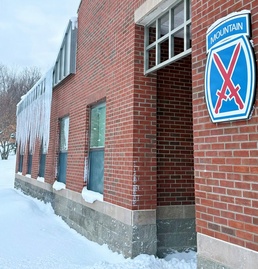
FORT DRUM, N.Y. (Jan. 22, 2026) -- Winters in the North Country can be harsh and unpredictable. To address this, Fort Drum officials follow an established weather call policy designed to balance mission requirements with the safety of Soldiers, Army civilians, and their families.
The installation’s weather call process is based on multiple factors, including forecasts from the National Weather Service and 18th Combat Weather Squadron, road conditions on and around the installation, and input from multiple organizations, including the directorates of Public Works, Emergency Services, and Plans, Training, Mobilization and Security.
Under this policy, installation leaders may implement a Delayed Report, Early Release, or Do Not Report order.
The Decision Process
Rich Hughes, the installation emergency manager, said Fort Drum personnel are notified of the initial weather call before 4 a.m.
“Many of our Soldiers and civilian employees live across the North Country and report to work early each day, so we want to get the information to people for their awareness before they begin their morning commute,” he said.
The early decision also allows Fort Drum DPW snow removal crews to clear roadways and lots, unimpeded by normal traffic. Additionally, the installation informs local school districts about on-post conditions to inform their separate decisions on delays or closures.
If weather conditions worsen, the data collection process is repeated for a potential status change before 7 a.m.
“If the severe weather is projected to continue, or roads and parking lots can’t be cleared even by the delayed reporting time, we may recommend a ‘Do Not Report’ for non-essential personnel,” Hughes said.
For severe weather developing during the duty day, an early release decision is made before 11:30 a.m.
“If we’re already here and see that severe weather is going to impact the afternoon hours and/or the drive home, we may recommend an early release to prevent personnel from having to drive in hazardous conditions,” he added.
Hughes said the weather call policy is reviewed annually as part of a broader effort to maintain readiness while reducing unnecessary risk during severe weather events.
“There is so much more that goes into a decision than what the weather looks like at any given moment,” he said. “It’s not an exact science, but it is as informed a decision as we can make it based on multiple factors.”
These include:
The ability to clear snow in time for personnel to report for duty
Current weather and road conditions across a 40-mile commute radius, which involves canvassing local law enforcement agencies, monitoring travel advisories and bans in the tri-county area, and tracking 511NY.
Forecasted weather conditions across the commute radius for the entire duty day. The unpredictability of lake effect snow bands in some areas can make this difficult to project. Any minor variations to wind speeds and directions can greatly affect the amount of snow.
Mission-essential activities such as deployments, redeployments, special events, and critical training. The command team may designate certain activities as mission-essential to ensure personnel are available.
Staying informed
Information on post status, road conditions and how weather impacts Fort Drum is available at https://home.army.mil/drum/about/post-status-weather-alert-messaging and accessible through MAPA (My Army Post App). Status updates are also posted at http://www.facebook.com/drum.10thmountain. Community members can also call the Fort Drum Information Hotline at (315) 772-3786 for road conditions, and delay and closure information.
Hughes said the Alert! mass warning notification system is the fastest way for personnel to receive emergency messages via email, text, phone call and on government computers. They can also add family members’ contact information to receive messages. Soldiers and civilian employees can register at https://usg01.safelinks.protection.office365.us/?url=https%3A%2F%2Fservices.alert.mil%2F&data=05%7C02%7Cmichael.f.strasser.civ%40army.mil%7Ca0814fadd67e42f84c7808de59cf8ef6%7Cfae6d70f954b481192b60530d6f84c43%7C0%7C0%7C639046945163088105%7CUnknown%7CTWFpbGZsb3d8eyJFbXB0eU1hcGkiOnRydWUsIlYiOiIwLjAuMDAwMCIsIlAiOiJXaW4zMiIsIkFOIjoiTWFpbCIsIldUIjoyfQ%3D%3D%7C0%7C%7C%7C&sdata=dMmurzaNW2C1Z9c4RiCxdXdqHWjiE0bwnAG9YJPYdsw%3D&reserved=0 (government computer required).
“The bottom line is, this is the North Country,” Hughes said. “We must be cautious but resilient during the weather, because it will and does snow often. The commander’s decisions are based on keeping people safe, while ensuring we can still accomplish our mission.”
Winter Driving Tips
The drive into work or back home can feel exhausting John Rebelo, Garrison Safety Office, emphasizes “See and Be Seen” as the fundamental principle of safe winter driving. He offers the following advice:
“This will ensure you are able to view the traffic around you and prevent snow piled on the roof from sliding onto your windshield when you apply the brakes,” Rebelo said. “Visibility at all times is key to preventing an accident.”
Check your tires. Proper inflation provides better traction and braking on slick roads.
Use windshield wiper fluid rated for freezing temperatures.
“This helps clear road splash from the windows and reduces ice from building up on the windshield,” Rebelo said.
“This allows more time to react to sudden vehicle stops,” Rebelo said. It can also prevent accidents when you apply your brakes and need additional distance due to slippery conditions.”
For more winter weather driving tips, visit http://www.nhtsa.gov/winter-driving-tips.