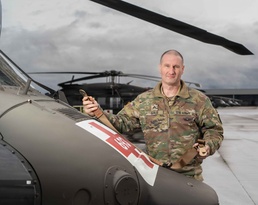
New litter strap design developed by Oregon aircrews will equip all Army MEDEVAC units
SALEM, Ore. – An innovation born from operational necessity on the flight line in Salem has become the new standard for medical evacuation operations across the entire U.S. Army.
Oregon Army National Guard aircrews with Golf Company, 1st Battalion, 189th Aviation Regiment, identified and solved a critical equipment compatibility issue that threatened to limit the use of cutting-edge rescue technology. Their solution – a redesigned litter strap designated SK-1189-V and named after their unit – has been certified by the U.S. Army Aeromedical Research Laboratory and will now be issued to every MEDEVAC unit in the Army.
"I'm happy that the legacy we've built in Oregon from Golf Company, 1-189th Aviation, will be represented in this new technology," said Chief Warrant Officer 4 Josiah Zeiner, Aviation Safety Officer with 2nd Battalion, 641st Aviation Regiment. "Oregon has a part in making this a reality."
The innovation emerged during training on June 18, 2025, when Oregon became only the third unit in the Army to receive the Vita Vertical Rescue System (VRS), an advanced hoist stabilization technology that eliminates dangerous spinning during helicopter rescue operations.
"We realized that the seat belts that the Army outfitted the Black Hawk helicopter with were not long enough to go over the top of the litter and patient with the VRS device connected to the bottom of the litter basket," Zeiner said. "That was the moment when we realized that this was a great device, but it still had some refining that needed to be done."
The VRS represents a significant advancement in rescue capabilities. The device uses four fans and air pressure to automatically stabilize rescue baskets during hoist operations, eliminating the need for taglines – ropes that crew members traditionally use to prevent spinning.
"We've never had any litter spin out of control in the Oregon Army National Guard," Zeiner said. "But we have had challenging situations with very high hoists over 280 feet, where the tagline is only 300 feet. This device would eliminate, in certain scenarios, the need for a tagline, and we could just hoist straight up at full speed."
Rather than wait for a solution from higher headquarters, the Oregon aircrews took initiative. Sgt. James Gale, a crew chief with Golf Company and a Heavy Equipment Technician with the Oregon Department of Transportation in his civilian career, was among those who identified the problem during initial testing.
"We made the recommendation that this is very simple with the Cobra straps for when you're on mission," Gale said. "They just need to be longer. In our testing, we found that the easiest thing to do with the VRS is load it directly to the floor using the D-rings, rather than onto the litter pan."
The Oregon team collaborated with Skedco, a manufacturer of rescue equipment, to develop the solution. They evaluated existing Army litter strap designs for different Black Hawk configurations, incorporated the best features, and developed prototypes.
"We took an existing Skedco strap, the SK-958, lengthened it, and added a Cobra buckle to allow us to hook it to the different Black Hawk floor configurations and quickly disconnect the strap," Zeiner explained. "We did two prototypes to get the final design correct, then made 10 prototypes. We kept seven in Oregon and sent three to the Army Aeromedical Research Laboratory for testing."
The design centers the Cobra buckle over the patient and accommodates two different Black Hawk floor configurations, reducing the time required to secure and release patients.
"When somebody's injured, every second matters," Zeiner said. "We took a lot of time and effort making sure we got the design right."
After evaluation at Fort Rucker, Alabama, the laboratory certified the strap for airworthiness and submitted it for inclusion in the Army's standard equipment package for the VRS. The process took approximately six months from problem identification to Army-wide adoption.
On January 21, 2026, Oregon aircrews used the new strap system in training for the first time following its airworthiness certification, marking the system fully operational.
"The Oregon Army National Guard is committed to using the latest technologies and advanced procedures to provide the best possible care, not only to soldiers, but to the citizens of Oregon that we rescue," Zeiner said.
Oregon MEDEVAC crews regularly conduct high-risk rescue operations throughout the state, from Mount Hood climbing accidents to wildland fire rescues and flood evacuations.
"The amazing part about this job is actually what we get to do," Gale said. "In the summertime, we're out fighting fires, rescuing stranded hikers off the side of mountains. In the wintertime, we do that quite a bit as well. It's not just doing what the Army expects of us – we actually get to serve our community."
Gale has participated in numerous memorable rescues, including extracting a climber on Mount Hood who had fallen 600 feet and suffered severe injuries, and conducting flood rescues in Hermiston in 2020.
As Oregon aircrews complete training on the VRS and new strap system, they will be ready to employ the technology on rescue missions throughout the state.
"Once the airworthiness release is completed, it will be up to the individual aircrews to decide if this is the right tool for a specific rescue," Zeiner said. "There's a good possibility that we'll have crews ready to employ this device on a real rescue very soon."
The innovation represents another example of Oregon National Guard leadership in advancing military aviation capabilities. The designation SK-1189-V ensures that Golf Company, 1-189th Aviation, will be permanently associated with this life-saving equipment improvement across the Army.