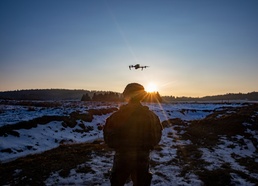
HOHENFELS, Germany — Opposing Force (OPFOR) Soldiers assigned to 1st Battalion, 4th Infantry Regiment, Joint Multinational Readiness Center, are improving their small unmanned aircraft systems (sUAS) proficiency through a Drone Validation Course at Hohenfels, Germany, Jan. 19-23, 2026, strengthening their ability to replicate modern battlefield threats during rotational training held at JMRC.
Staff Sgt. Sam Gordon, the 1-4 Inf. Regt. sUAS master trainer, said the course ensures OPFOR drone operators can employ multiple unmanned platforms while providing realistic training conditions for rotational units.
“What we do here at 1-4 is threat replication,” Gordon said. “My job is to train Soldiers how to use sUAS equipment.”
Gordon said the Drone Validation Course focuses on several categories of systems used in training scenarios.
“Our goal is to put up sUAS systems — stabilized quadcopter-type drones, fixed wing drones or first-person view (FPV) drones — that replicate what the enemy is using on the battlefield,” he said.
The course trains OPFOR Soldiers to maximize system capabilities and operate in challenging conditions.
“The main things that we’re trying to get operators to do is to use them to the full capacity of the system,” Gordon said. “Whether that’s their thermal optics or their daytime optics, we want them to be able to fly these systems day or night in as many conditions as possible.”
Gordon said the intent is to mirror enemy unmanned reconnaissance and targeting capabilities that can observe units, identify personnel and vehicles, and deliver timely reports to commanders.
“Our goal is to put out a realistic threat that can observe day or night with thermal optics and identify vehicles and personnel,” Gordon said.
OPFOR UAS teams also support ground maneuver elements by enhancing situational awareness.
“Our goal in integration with ground maneuver elements is to enable the maneuver instead of hinder it,” Gordon said. “We want the drones to be a force multiplier and help the units on the ground have situational awareness of what’s going on around them.”
One of the major challenges in the training environment, Gordon said, is terrain and communications limitations.
“One of the biggest challenges we have in this environment is the (radio frequency) propagation,” Gordon said. “The terrain makes it very difficult for the ground stations to push the ranges on those platforms.”
Despite those challenges, Gordon said the training helps Soldiers develop skills that can translate to future assignments across the Army.
“Whatever platform they get at their next unit, they’re going to be able to take the knowledge they got here and apply that to a new system,” Gordon said.
Gordon described OPFOR’s role as essential to readiness, emphasizing the importance of realistic and persistent threat replication for rotational units training at JMRC.
“We’re your sparring partner,” Gordon said. “We’re here to help you get better. And we’re going to put up a threat that is realistic and persistent and constant.”