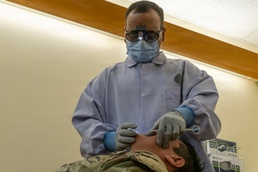
FORT HOOD, Texas – Army Reserve Soldiers of the Kirksville, Missouri-based 7240th Medical Support Unit and the Columbia, Missouri-based 7406th Troop Medical Clinic have respectively been providing medical and dental staffing and support to the Deployment Readiness Center here, as well as to the TMC 14 in North Fort Hood, Texas, during both unit mobilizations here.
The mobilization of the 7240th MSU and the 7406th TMC is part of a continuity of rotational units under the organizational umbrella of the Pinellas Park, Florida-based Army Reserve Medical Command. The DRC mission comprises of processing, clearing and validating service members and civilians throughout the Total Army and in support of the Fort Hood Mobilization Force Generation Installation, or MFGI, platform.
Army Reserve Maj. Mendy Martinez, a nurse practitioner with the 7240th MSU and medical director of the DRC, said she and her Soldiers ensure to identify and resolve any issues with personnel in both their mobilization and demobilization phases.
“The mission of the 7240th MSU here at the Deployment Readiness Center is to ensure that service members are medically and administratively ready to deploy and really gives Commanders that peace of mind in overseas and on deployments that their service members are ready for the mission,” said Martinez.
Furthermore, the 7240th MSU operates in tandem with the 7406th TMC whenever additional services and resources are necessary to efficiently and expeditiously clear service members and civilians.
“The areas of medical readiness that the 7240th MSU provide here at the Deployment Readiness Center are audiology, dental and optometry,” Martinez said. “We have them go through the medical clearance with the providers – typically medical doctors, PAs and nurse practitioners – but we also have the TMC 14, and that’s if we need any additional medical clearance or guidance from the TMC. They will actually do physical exams, refer out and also handle real-world medicine for us.”
Army Reserve Sgt. 1st Class Michael Melgoza, a combat medic with the 7240th MSU and the medical noncommissioned officer in charge of the DRC, said he implores all troops and civilians going through medical and dental readiness processing here to be as honest as possible.
“You need to be as honest as possible because our best intent is to help the individual the best that we can, and you want to honest about that because you don’t know what those conditions are like out there, and we want to make sure that we are helping you to the best of our ability and protecting the Soldier,” said Melgoza.
Furthermore, this applies to personnel returning home who may require supplementary care and appointments up to 180 days after the end of their mobilization orders, Melgoza said.
U.S. Army Reserve Sgt. Jackson Marsch, a combat medic with the 7406th TMC and emergency medical services technician in his civilian capacity, said this real-world medical mission has been greatly conducive to his professional growth and development.
“I definitely been able to practice a little bit more outside my scope of practice working in EMS,” Marsch said. “I’ve been able to give IVs here, which is nice to be able to get more hands-on training with that.”
Additional opportunities for training include operating an electrocardiogram and shadowing physician assistants as part of the Interservice Physician Assistant Program, said Marsch.
Overall, the success of the MFGI rotational mission is not completely possible without the support of loved ones, Melgoza said.
“To friends and family, just thank you for all your support,” said Melgoza. “It means so much to us and helps us really accomplish the mission and focus on what is we have to do as Soldiers of the United States Army.”