Quiescent tomographically-detected macular neovascularization—It’s the kind of term that would scare the staunchest Defender—dense, technical, and intimidating at first glance.
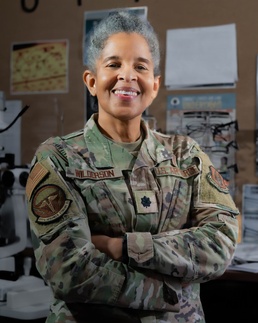
“It’s not as daunting as it sounds,” said Lt. Col. Leslie Wilderson.
Behind the terminology is a deceptively simple clinical question: not whether abnormal blood vessels exist in the eye, but whether they are actively causing harm. In eye care, one of the most consequential decisions a clinician makes is not whether abnormal blood vessels are present, but whether they are active. Treat too early, and patients may undergo unnecessary invasive procedures. Treat too late, and vision loss can become permanent. That narrow clinical margin—where judgment matters as much as technology—is where a recent article written by a Reserve Airman is reshaping how clinicians evaluate disease progression.
Lt. Col. Leslie Wilderson serves as the Optometry Officer-in-Charge for the 911th Aeromedical Staging Squadron at Pittsburgh International Airport Air Reserve Station, where she oversees vision readiness for more than 1,500 Steel Airmen. This includes aircrew members whose visual performance is critical to mission execution. In her civilian role, she is a staff optometrist with the Northeast Ohio VA Healthcare System. Her work at the intersection of civilian medicine and military service recently earned national recognition from the medical community.
Wilderson received the Journal of Medical Optometry’s Article of the Year award for research that advanced how clinicians interpret advanced imaging when managing macular neovascularization, a condition associated with age-related macular degeneration and a leading cause of irreversible vision loss. The award was presented in November 2025 at the American Academy of Optometry in Boston and reflected peer recognition of work that challenged conventional approaches to diagnosis and treatment timing.
“Your macula is responsible for your central vision and macular degeneration is when the cells that nourish your retina die,” said Wilderson. “Patients are pretty familiar with macular degeneration being dry or wet—one is treatable and one is not.”
Dry macular degeneration involves the gradual thinning and deterioration of the macula due to a buildup of deposits under the retina, often resulting in gradually worsening, blurry central vision. Wet macular degeneration occurs when new, abnormal blood vessels grow beneath the retina, leaking fluid and blood that damages the macula and can lead to rapid and severe vision loss.
“The body's always trying to repair itself," said Wilderson. “But when the eye does that, those new blood vessels can be bad.”
The development of those abnormal blood vessels is what Wilderson describes as “neovascularization” and is linked to “wet” macular degeneration. While the presence of these vessels has long been recognized as a risk factor for disease progression, determining whether they are actively causing damage has remained a clinical challenge. Using optical coherence tomography angiography (OCTA), an advanced imaging technology, Wilderson’s investigations demonstrated that the morphology of these vessels—how they take shape, thickness, and branching patterns—can provide meaningful insight into disease activity.
“That's what I discovered, that you can just watch it because a lot of times they'll just transform or other factors will come into play,” said Wilderson.
Certain configurations, she found, may appear concerning but remain stable and inactive for extended periods. Others subtly transition toward activity, signaling a need for closer monitoring or treatment. By documenting these distinctions, the article helped clarify when observation may be appropriate and when intervention becomes necessary.
“So that's why I named it quiescent, because it was just quietly there,” said Wilderson. “I thought it was a beautiful word instead of saying inactive. It's quietly evolving and I didn't want to give the impression it was something you did not have to worry about. I wanted people to know it could go either way.”
The study followed a patient over a two-year period, illustrating how a lesion initially remained inactive before later demonstrating signs of progression. This long-term observation reinforced the importance of careful surveillance and informed clinical decision-making, particularly in cases where premature treatment could expose patients to unnecessary risk.
Her work continues to span complex and sometimes rare diagnoses. In another case now being prepared for publication, Wilderson identified subtle optic nerve swelling in a patient experiencing vision loss and referred the patient for advanced imaging. The resulting MRI revealed a glioblastoma, underscoring how careful clinical evaluation can uncover life-threatening disease well beyond the eye.
“Those are the weeks you can't sleep at all because you're so worried about the person," said Wilderson. “These cases make interesting papers, talking points and conversation. But there's a real person behind that. It's heavy. There are so many of them and you just want them to be ok.”
The editorial board of the Journal of Medical Optometry recognized the work for contributing a practical, patient-centered perspective to a complex clinical problem. By reframing how advanced imaging findings are interpreted, her investigations offered clinicians a more nuanced approach to balancing early intervention with cautious observation.
While the award reflects civilian peer recognition, the impact of Wilderson’s work extends directly into her military role. At the 911th Aeromedical Staging Squadron, she applies the same analytical approach to aerospace optometry programs that support force readiness. Vision standards for Airmen—particularly aircrew—are exacting, and maintaining readiness requires both technical expertise and sound clinical judgment.
Lt. Col. Eric P. Baldwin, the commander of the 911th ASTS, lauded her continued professionalism within her field and military service.
“I have had the privilege of witnessing her exceptional professionalism, leadership, and dedication firsthand,” said Baldwin. “Lt. Col. Wilderson’s expertise is substantiated by a distinguished career as a civilian Optometrist. Within our unit, Lt. Col. Wilderson is one of my top officers and has been a huge asset in evolving the programs here at the 911th ASTS. She consistently demonstrates the highest caliber of leadership and has been instrumental in advancing our Wing's capabilities and readiness. Lt. Col. Wilderson is an exemplary officer and a highly accomplished medical professional. Her work ethic, clinical expertise, and unwavering commitment to service make her an invaluable asset to both the United States Air Force and the medical community.”
In addition to overseeing routine vision readiness, she manages specialized programs that support aircrew performance and contributes to force development within the Biomedical Sciences Corps. Her background in advanced diagnostics and evidence-based care strengthens the squadron’s ability to deliver high-quality medical support aligned with operational requirements.
Her career illustrates a defining strength of the Air Force Reserve: the integration of civilian expertise into military service. Reserve Officers often serve as leaders in their civilian professions, bringing current practices, specialized knowledge, and innovative thinking back into uniform. That exchange benefits both domains—advancing professional fields while enhancing military capability.
For the 911th Airlift Wing, Wilderson’s recognition highlights the depth of talent resident within its formations. The same Airmen responsible for readiness on station are contributing to national conversations in medicine, science, and technology beyond the installation. Their civilian achievements reinforce the wing’s operational credibility and underscore the value of a force built on diverse professional experience.
From the clinic to national fieldwide recognition—and back to the mission—Wilderson’s work reflects how Reserve service amplifies professional impact. By advancing medical understanding in the civilian sector and applying those insights to military readiness, she represents the kind of expertise that strengthens the force and not so quiescently elevates the standard of care for those it serves.