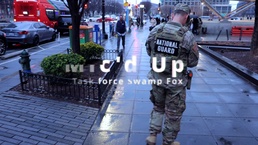
WASHINGTON — Rain hangs in the air as the city settles into a Friday-night rhythm. Streetlights cast a soft sheen on wet pavement near the Navy Yard, and the Metro breathes commuters in and out like clockwork. In the middle of it all, Army Lt. Col. Brunson DePassmoves at a steady pace, checking in on Soldiers the way he believes leaders should—up close, unannounced, and in the same weather.
“Y’all need anything? Are you good?” DePass asked as he paused near a team posted outside a station entrance, scanning the sidewalks and the steady line of people heading home.
DePass, a South Carolina National Guard officer, commands Task Force Swampfox, a task force comprised of Guardsmen from South Carolina and Georgia supporting the D.C. Safe and Beautiful mission. On any given evening, his Soldiers split between roving patrols and Metro coverage—outside entrances, inside mezzanines and, when needed, down on the platforms where crowds gather and frustrations rise when trains run late.
“Protecting the Metro is a very important part of this mission,” DePass said. “And then the roving patrols, like what we saw at the Wharf—we’re patrolling the areas where small businesses and restaurants operate. It’s supporting the people of D.C., both tourists and citizens, and supporting all the law enforcement agencies, with special emphasis on the Metropolitan Police Department.”
For DePass, the most important part of the night is not the route itself—it is the chance to see the mission through his Soldiers’ eyes and make sure they feel seen in return. He frames it as an obligation, not a perk of command.
“It’s important for me to be out there with my Soldiers for several reasons,” he said. “First and foremost, I never want to ask anybody to do something that I’m not willing to do. And it’s important to be out here sharing this experience with my Soldiers, but also inspecting what you expect—making sure we don’t forget what right looks like.”
As he moved from one location to the next—Waterfront, Navy Yard-Ballpark and Federal Center—DePass kept the tone light when he could, trading quick jokes and encouragement, but he never lost sight of why he was there. At each stop, he checked posture, spacing and situational awareness, reminding teams to keep their heads up and maintain a full perimeter.
“Spread out. You want that 360,” he told one group. “Support the Metro police, and make sure we look out for ourselves.”
The mission, he added, is built on presence and relationships. That means helping when help is needed—sometimes in small, human ways that make a long day easier. Earlier in the evening, a roving patrol assisted a familiar face in the area, helping him get from one location to another. At another stop, a station manager known to the Soldiers checked in, a small moment that reflected a growing comfort between agencies and the Guardsmen posted in their space.
“This Metro station has been really good about working with us,” DePass said. “They’re really supportive. We’ve done a good job of working with them and building the relationship—mutual support. It’s been really good.”
In DePass’ view, those routine interactions are not incidental; they are the work. A deterrence mission is measured as much by what does not happen as by what does, and he believes success depends on how Soldiers carry themselves in public.
“A lot of people, this is what they think of not only the National Guard or the Army, but the military,” he said. “We want to make sure we’re putting the best foot forward.”
He pointed to a shift in public sentiment as one of the clearest indicators that the mission is making progress. DePass said he saw a sharp contrast between his initial visit in early November and what he has experienced since returning.
“I probably saw as many negative things that weekend as I have since I’ve been back on mission,” he said.
Now, he said, interactions are more often supportive—thank-yous, nods and brief conversations with residents and visitors who say they appreciate seeing Soldiers on foot instead of only in vehicles. DePass believes that shift is tied directly to professionalism and a simple approach he repeats often.
“Be nice to people,” he said. “Don’t make a permanent solution to a temporary problem.”
That mindset shapes how Task Force Swampfox positions around the Metro, where crowds pause, wait and concentrate. DePass views those moments—people standing still, tired after work, shoulder-to-shoulder near turnstiles and platforms—as the places where presence matters most.
“When they get to the Metro, they’re waiting,” he said. “That’s where you find people standing still. There’s more opportunity for interaction, both positive and otherwise.”
It is also where visitors form some of their strongest impressions of the capital. DePass said he thinks about that often, especially at stations and corridors packed with travelers headed to hotels, restaurants and landmarks.
“These are visitors,” he said. “They’re going to leave here and go back home, and they’re going to say, ‘How was D.C.?’ We want people to want to come to D.C.”
As the night stretched on, DePass continued to move between teams, pausing to listen, check conditions and remind his Soldiers that leadership is not a voice over the radio—it is a presence in the rain.
“The main thing about checking on Soldiers is upholding a standard,” he said, “but also letting them know the leadership—the sergeant major, the executive officer, all of us—we’re willing to come out, whether it’s rain and cold, and be involved and be on patrol as well.”
For Task Force Swampfox, the route is never just a route. It is a message—shared across Metro stations, sidewalks and business corridors—that the Guard and its partners are present, coordinated and committed to keeping the nation’s capital safe, orderly and open.
“From my foxhole,” DePass said, “our Soldiers have enjoyed the mission so far and look forward to continuing to do a great job.”