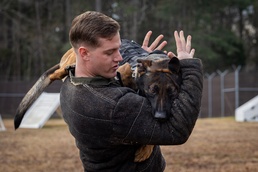
Military working dog handlers are one of several secondary military occupational specialties within the Military Police community, playing a key role in maintaining base security. Through constant training and daily operations, handlers and their dogs operate as a team to identify potential threats to guard both the installation’s community and its assets.
Additionally, military working dogs act as a visible psychological deterrent for potential threats. Handlers and dogs operate as integrated teams trained to detect explosives or narcotics, track threats, support law enforcement, and force protection operations across the installation.
“We have day-to-day operations of not only the base but also mission critical assignments such as U.S. Secret Service missions,” said U.S. Marine Corps Gunnery Sgt. Jenna Cauble, the kennel master of Headquarters and Headquarters Squadron, Marine Corps Air Station Cherry Point.
Becoming a military working dog handler requires Marines to first qualify as an MP.
“You can’t just sign the dotted line for K-9, you have to earn your way in,” said U.S. Marine Corps Sgt. Andrew Sanderson, the military working dog trainer of H&HS, MCAS Cherry Point. “You must become an MP and then go on a board ... from there you need to be chosen for K-9 school.”
At the K-9 unit, they offer on-the-job training to MP that are interested in the competitive secondary MOS. To qualify, Marines are expected to demonstrate proficiency as both Marines and MP. Those interested may then be selected and sent to the K-9 handler schoolhouse.
“The job has driven my life the past seven years,” said Sanderson. “There is always something new each day. When it comes to training your dog, they’re just like people, they have emotions. One day they will give you an attitude and you’ll be like ‘this is new,’ so you are constantly troubleshooting.”
Serving as a military working dog handler provides Marines with a sense of purpose based on responsibility, trust, and teamwork. Handlers are entrusted not only with safeguarding the installation and its community, but also with the care, training, and development of their military working dog. The constant demands of the role and the direct impact of their work reinforce the importance of each handler’s contribution to the mission.
“You are a big asset to the watch and to the base. You have a dog that has huge capabilities, and it gives you the sense of ‘I’m needed,’” said Cauble. “The dog needs me, and we need each other to work as a team to do our job effectively.”
The military working dog community is one of the Marine Corps’ smallest MOS, united by pride in the mission and the bond handlers share with their dogs.
“When in the workplace there’s never anyone above you, never anyone behind you, but always beside you,” said Sanders. “Working here as a sergeant, you may be a corporal, but I am never above you. I am
beside you because in K-9 we work as a team.”
(U.S. Marine Corps story by Cpl. Casey Ornelas)