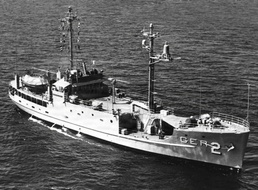
On Jan. 23, 1968, the USS Pueblo, a World War II Army cargo ship repurposed as a joint U.S. Navy and National Security Agency electronic surveillance ship, was attacked and captured by North Korea. Outfitted with state-of-the art equipment, the ship was posing as a scientific research vessel as it attempted to locate military radar and radio stations on the eastern coast of North Korea.
The refitted Pueblo left Japan on Jan. 11, 1968 for its first mission. For twelve days, it operated quietly in international waters off the coast of North Korea, until the fateful day North Korean gunboats and submarine chasers surrounded it, while fighter aircraft circled above. The North Koreans claimed the Pueblo had entered their territorial waters. Attempting to flee, the Pueblo was attacked, and one sailor was killed. The ship’s commanding officer, Lt. Cmdr. Lloyd Mark Bucher, surrendered, and the remaining eighty-two crew members were taken prisoner. Meanwhile, the ship had managed to notify U.S. forces in Japan of its circumstances, but no combat ships or aircraft were readily available to assist.
CW2 William Ragatz, a 36-year-old collection officer at U.S. Army Field Station Hakata in Japan, was immediately sent to South Korea to augment signals intelligence (SIGINT) personnel stationed there. The Nebraska native had enlisted as a Morse interceptor in 1953 and was appointed a warrant officer in 1965. For several months, as tensions rose, Ragatz and fellow Army Security Agency personnel worked around the clock, alongside others in the U.S. SIGINT community, covering North Korean communications targets to ensure decision makers at the Office of the Secretary of Defense had accurate and timely intelligence concerning the crisis.
Eventually, President Lyndon B. Johnson decided on a show of force, sending additional American naval power to the region and mobilizing 14,000 Air Force and Navy reservists. While the ship’s crew suffered in captivity, the U.S. conducted secret negotiations with the North Korean leaders to secure their release, finally, on Christmas Eve, 1968.
Aside from rescuing the crew, the United States’ biggest concern was that North Korea would gain knowledge of American cryptographic engineering developments aboard the ship. Prior to capture, the crew tried unsuccessfully to destroy the classified equipment and documents onboard the ship, which lacked a quick-destruct system. Some post-crisis evaluations and reports indicated that, while specific documents left behind on the ship were “not vital”:
"…the probable compromise of the logic of these modern electronic cryptographic equipments [sic] is a major intelligence coup without parallel in modern history…. [W]hile we have most likely been successful in minimizing losses in terms of specific messages, the technology and doctrine loss may well have major long-term effect."
This information could be used by U.S. adversaries, particularly the Soviet Union, to increase their communications security procedures and develop more secure cryptographic hardware.
Intelligence officials noted that, following the Pueblo’s capture, the North Koreans did make changes in their communications security, which would hamper U.S. ability to intercept their messages. They believed U.S. communications, however, remained secure because of daily changing variables. [Only later would it become known that U.S. Navy radioman John Walker and his espionage ring were providing these keying materials and other classified information to the Soviets from December 1967 through 1985.]
As a result of the Pueblo incident, immediate corrective measures included limiting onboard classified technical material to that absolutely essential to the mission, increasing the armament on similar ships, and providing armed escort ships for sensitive operations. Ultimately, by late 1969, the secretary of defense directed the Navy to eliminate all shipboard intelligence platforms.
Article by Lori S. Stewart, USAICoE Command Historian. New issues of This Week in MI History are published each week. To report story errors, ask questions, request previous articles, or be added to our distribution list, please contact: TR-ICoE-Command-Historian@army.mil.