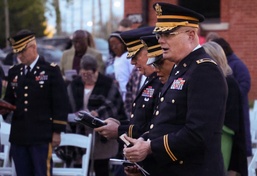
FORT KNOX, Ky. — John Breckenridge’s military legacy was borne in war on the South Pacific island of Guadalcanal in 1942.
A pragmatic thinker often finding opportunities that others might overlook, John had been thinking about how best to get into World War II after high school. In early 1942, he chose to enlist rather than being drafted.
Eighty-four years later John’s son, Chaplain (Lt. Col.) James Breckenridge of Fort Knox, said John saw more benefit in entering military service voluntarily.
“At that time, in the end of the month when the Army paid everybody – and they paid everybody in cash – he said if you were a draftee, you went to the end of the line. If you were regular Army, you got paid first,” said Breckenridge. “He laughed about it.”
Possibly the only active-duty Soldier currently with a parent who served in World War II, Breckenridge said it was his father’s military legacy that led him to start his own career in the Army in 1986.
During the war, John served 32 months in the South Pacific with 339th Fighter Squadron – a P-38 Lightning Fighter unit based at Guadalcanal in the Solomon Islands. John worked as a mechanic on Henderson Field, making sure the P-38s stayed mission ready and capable.
John was there in April 1943 when unit leaders got word to launch Operation Vengeance, a rare opportunity to assassinate Royal Japanese Navy Admiral Isoroku Yamamoto – the mastermind behind the Pearl Harbor attack Dec. 7, 1941, which killed thousands of sailors and ushered the United States into the war.
Much as Osama bin Laden would be after 9/11, Yamamoto was detested by the American public.
On April 14, 1943, https://www.nationalww2museum.org/war/articles/operation-vengeance-killing-isoroku-yamamoto intercepted a message describing in detail where and when Yamamoto would be landing in his G4M Betty bomber aircraft: at Japanese-occupied Ballale Island on April 18. Roosevelt was eager to exact revenge and approved of the mission.
The plan was for 18 P-38s from John’s fighter squadron, the 12th and the 70th to fly wave-top to the island at which point they would break into a four-aircraft “kill squad” with the rest providing cover and support.
When the pilots spotted Yamamoto’s formation, the attack squad was reduced to two aircraft because of mechanical issues. One or both remaining pilots closed in and together pierced Yamamoto’s aircraft with 50-caliber gunfire, sending it crashing into the nearby forest.
No survivors. Mission complete.
“My father talked about that all his life,” said Breckenridge; “he was in the unit that got Yamamoto.”
John met a lady named Jean through correspondence during the war. A mutual friend had introduced them. Love blossomed with each letter until April of ’45; shortly after returning from the war, John married Jean.
John remained in what would become the Air Force until retirement, steadily climbing the enlisted ranks. During his time in the military, he fathered two children and adopted a third, with Breckenridge arriving in 1964, several years after his sister Joy and brother Jay.
Breckenridge said John filled the household with discipline and love.
“He was very much a military man, but my father also loved me very much,” said Breckenridge. “He could be a strict disciplinarian at the time but despite the fact that he was a military man through and through, he was a very loving father to me – a great parent and a wonderful moral example to us children; both of my parents were.”
Breckenridge said when his father found out he planned to join the military after high school John urged him to become a commissioned officer instead of enlisting. Breckenridge honored his father’s wish, graduating from Virginia Military Institute and commissioning as an Air Force second lieutenant in engineering.
“He wanted me to go into the military, and once I told him I wanted to go into the military, he told me lots of stories to try and inspire me,” said Breckenridge. “Unfortunately, at the time it didn’t mean that much to me. Fortunately, I was able to supplement some of what he said to me.”
One story that stuck with Breckenridge involved a friend of John’s – Julian Brantley. They had enlisted together, went through basic and Advanced Individual Training together, and found themselves serving on Guadalcanal together during the war. They remained friends for years after.
“Brantley and Breckenridge. They went to basic at Keesler Field, Mississippi,” said Breckenridge. “While they were in basic training, instructors gave them all an IQ test. If they scored above 115, they were selected for the Army Air Forces.”
Both men passed the test and were moved to the Air Forces rather than becoming infantrymen.
“That changed the entire future of dad’s life,” said Breckenridge.
While at AIT in San Diego, all the men were given the opportunity to either volunteer for the Atlantic Theater or Pacific Theater. Breckenridge said most enlistees wanted to be stationed in Europe.
As a result, the instructors said anyone who volunteered for the Pacific could get a free weekend pass in Los Angeles.
“My dad was from West Virginia and Brantley was from East Tennessee – two Appalachian boys – but my dad was also street smart,” said Breckenridge. “My dad told Brantley, ‘Listen, both of us are at the beginning of the alphabet so if they need people for the Pacific, they’re going to just choose people from off the top of the alphabet. Why don’t we take up their offer for a weekend in Hollywood instead?’
“So that’s what they did.”
Breckenridge said his dad knew how to take advantage of a bad situation to work it in his favor. On the ship ride over to Guadalcanal, the troops were fed baked beans for breakfast every day. Although tasty, they didn’t sit well. Below the deck where everybody slept, it stayed hot and smelly.
“Dad found a cot somewhere – just one, not two – so the two of them slept boot-to-head on the deck of the ship on this one cot the entire way over,” said Breckenridge, laughing. “During the day, they were somehow able to hide it and never get caught.”
Breckenridge said he was between the 3rd and 4th grade when his dad eventually retired as a chief master sergeant – he had been nominated to the Air Force’s highest position as Chief Master Sergeant of the Air Force but missed it by one.
Honorable discharge. Mission complete.
The family settled in Cedarville, Ohio. It would be 37 more years before John would see his youngest son go off to war. “I served in Afghanistan in and around Kandahar in 2010 to 2011,” said Breckenridge.
Two years later, at the age of 93, John died. Breckenridge’s mother died seven years later at age 96.
From Breckenridge’s entrance into the Air Force in 1986, John would witness his son leaving the Air Force six years later, but not before finding and marrying his wife while serving at Osan Air Base in Korea. John would witness his son devote 11 years outside of the military attending and graduating from Mid-America Baptist Theological Seminary in 1998 with a PhD, having two children, joining the Army Reserve, and reentering active duty in 2006 as a full-time chaplain.
It was John’s legacy of Christian faith that would set Breckenridge on the lasting enduring path to retirement later this year. John’s faith legacy was borne not in war but tragedy a few years after leaving the South Pacific.
“My mother’s family were devout Christians, but my father was not,” said Breckenridge. “He didn’t really give his life to Christ until he had a really bad car accident in 1951.”
Breckenridge said his father spent several months in Walter Reed Army Medical Center healing from a broken neck and knee. It was John’s continued faith from then on that moved Breckenridge to change the course of his own life.
Breckenridge attributes his own military path to his father’s legacy.
“My parents were very patriotic, so growing up I was intrigued with the military,” said Breckenridge. “I couldn’t see working in the private sector – for what? Money? It didn’t hold any interest in me. I wanted to work for a cause that was bigger than me.”
Breckenridge went into the chaplaincy for the very same reasons – service bigger than himself and that legacy that John had built over years.
John spent 36 months of his life on his feet, standing for the wellbeing of the United States. John spent countless hours throughout his life on his knees, standing for the wellbeing of his family.
Through tears, Breckenridge said if given one more chance to speak to his father, he would thank him.
“I would thank him for – the example that he was to me as a Christian man, and – the hours and hours he prayed for me,” said Breckenridge. “My dad prayed for an hour a day, and I’m sure much of that was for me. I’m very grateful for his example, and his loving encouragement and his – prayers for me.”
Mission complete.