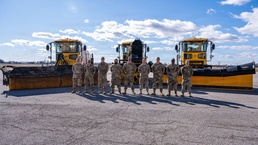
When winter weather hits Scott Air Force Base, most people see snow-covered roads and early-morning alerts. Behind the scenes, Airmen across the 375th Air Mobility Wing work around the clock to keep the mission moving.
A major part of that effort comes from the 375th Civil Engineer Squadron’s pavement and equipment operations flight, whose Airmen operate and maintain the heavy equipment essential to snow and ice removal across the installation.
“It’s often overlooked,” said Airman 1st Class Evan May, 375th CES pavement and equipment journeyman. “There’s a big group of people staying up all night and working nonstop to ensure safe routes for mission essential personnel.”
Not only does their team clear 59 miles of roadway for travel, but they’re also responsible for the snow and ice removal on two separate airfields, connected by a 1.5-mile-long taxiway. Their mission is paramount to not only the 375th, but to the operations of the 126th Air Refueling Wing and 932nd Airlift Wing.
Preparation for winter weather begins months in advance. Airmen test vehicles and coordinate with vehicle maintenance to ensure the equipment is ready for extreme conditions.
“We usually begin preparing for snow events in either September or October,” said May. “We’ll go out and check all our snow equipment and start planning when to host snow training to get our augmentees up to speed on snow ops.”
When winter weather is forecasted, the operational tempo increases. CE Airmen monitor conditions around the clock and stay in close coordination with the 15th Operational Weather Squadron, Airfield Management, and base leadership.
“When weather gives us the call that snow is a possibility, we switch over to night shifts and prepare all personnel and equipment,” said Airman 1st Class Joshua Roache, 375th CES pavement and equipment journeyman. “All Dirt Boyz are snow equipment trained, so we are all ready to go wherever snow or ice removal is needed.”
Snow removal operations follow established priorities, with the airfield receiving immediate attention. Runways, taxiways, and the MidAmerica St. Louis Airport runway connected to Scott are cleared first to ensure inbound aircraft have a safe place to land during winter conditions. Teams adjust techniques as weather changes, using plows, brooms, or deicing materials as needed.
Despite the freezing temperatures, reduced visibility, and physically demanding conditions, CE Airmen remain focused on creating a safe environment for Scott Air Force Base. They ensure its 13,000 personnel can safely get to work, emergency vehicles can respond without delay, and the installation remains operational.