CAMP NOTHINGHILL/BONDSTEEL, Kosovo – Drones, commonly used for recreational purposes, have rapidly evolved into tools for surveillance and military operations. However, when unidentified, unmanned aircraft present significant safety hazards to aviation and security risks to military forces.
Within the NATO-led Kosovo Force (KFOR) peacekeeping mission, this multinational force is tasked with providing a safe and secure environment, as well as ensuring freedom of movement for all people in Kosovo.
That is why KFOR Regional Command-East has prioritized training on Counter-Unmanned Aerial Systems (C-UAS) to enable soldiers to identify, target, and disrupt possible unauthorized UAS threats.
“The biggest threat right now with drones is that they are capable of carrying a payload,” said U.S. Army Master Sgt. Kai Waters is a part of the Counter-UAS Program for the 21st Theater Sustainment Command, which supports U.S. Kosovo Forces. “We don’t know if that payload is going to be a chemical or biological attack, an explosive or a weapon system attack.”
Drones also pose a risk to aircraft traffic and are therefore banned at airports. To meet these challenges, soldiers are taught to expand their observations from the ground to the skies during their mission in Kosovo.
KFOR Regional Command-East Latvian, German, and most recently, U.S. forces have their own authorized UAS to aid in patrols, which reinforces the need for practical Counter-UAS training to distinguish approved operations from potential threats.
“We want to make sure that, especially, the soldiers here in Kosovo know that if they do see drones in the area and they can document it, and they have the means to take care of themselves,” said Waters.
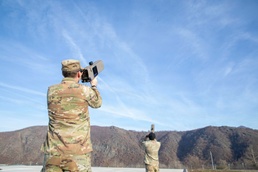
Waters is also a Chemical, Biological, Radiological, and Nuclear Operations NCO and visited KFOR U.S. and Slovak soldiers to train on a Dronebuster system, a handheld device designed to counter drone threats.
“I learned how to operate the drone buster and its capabilities," said KFOR RC-E U.S. Army Infantryman Spc. Hunter Hare. "I feel it adds another layer of protection for us while on patrols, and I hope I can use this class to protect myself and fellow soldiers from drone threats if and when the time comes."
Dronebusters counter drone threats by disrupting the drone's control frequency, forcing it to return to its operator. They can also interfere with GPS/GNSS signals, causing drones to hover, land, or crash, depending on their programming.
“The world is changing, and as the world changes, the military has to understand how to implement and mitigate those risks,” said Waters. “The risk is evident and present.”
With this round of training complete, the U.S. contingent within KFOR is now fully equipped and prepared to employ Dronebusters in response to potential UAS threats.