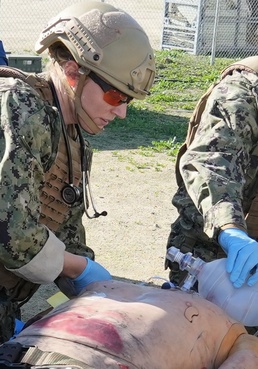
CAMP PENDLETON, Calif. — Lt. Cmdr. Rachel Robeck, a physician assistant (PA) assigned to Expeditionary Resuscitative Surgical System (ERSS) 15, based out of Navy Medicine Readiness and Training Command (NMRTC) Camp Pendleton, recently participated in an ERSS training conducted by the Naval Expeditionary Medicine Warfighter Development Center (NEMWDC) Dec. 9-16, 2025. Her hands-on experience highlighted the versatility and critical role PAs serve in Expeditionary Medicine.
ERSS teams are designed to deliver rapid, lifesaving surgical and resuscitative care in austere and operational environments. Within these small, highly specialized teams, PAs serve as adaptable clinical providers capable of filling multiple roles as patient conditions and mission demands evolve.
“My role as a PA allows the ERSS to have a lot of flexibility,” Robeck said. “With my background in emergency medicine, I can help triage patients, run or assist with resuscitations, provide procedural care, and, when needed, assist in the operating room.”
This breadth of capability allows PAs to bridge gaps between resuscitation and surgical care, particularly when team members are managing multiple patients or treatment areas. While an emergency physician may be focused on a critical patient and a surgeon operating simultaneously, the PA can assess overall patient flow, coordinate the team, and ensure adherence to medical regulations.
“Our department head likes to call me the ‘multitool’ of the team,” Robeck said. “I’ve really tried to embrace that. Being able to step back, look at everything happening at once, and help manage the bigger picture is an important part of the role.”
The ERSS training is designed to prepare Navy Medicine personnel to deliver forward surgical care in support of distributed maritime operations and expeditionary forces. Through realistic scenarios and interdisciplinary teamwork, students gain the skills and confidence needed to operate effectively in dynamic and resource-limited environments.
The ERSS training also provides opportunities to integrate with other Sailors, medical providers, and Marines, reinforcing the joint nature of Expeditionary Medicine and the importance of seamless teamwork from the point of injury through surgical intervention.
For Robeck, the training served as a reminder of the larger purpose behind maintaining clinical readiness.
“It reminds us why we spend time sharpening our skills,” Robeck said. “Ultimately, we do it so we can bring that experience back and be part of the Sailor-Marine team and support the mission.”
Robeck and the ERSS 15 team are currently assigned to the Naval Strategic Health Alliance for Readiness and Performance (SHARP), a partnership with Penn Medicine that embeds active-duty Navy trauma personnel into Penn Presbyterian’s Level I trauma center. This initiative sustains combat casualty care skills and provides hands-on experience with complex civilian trauma.
“I think I’m very lucky that my ERSS team gets to work in a civilian environment regularly to keep our clinical skills sharp,” says Robeck. “But coming out to this training really brings everything full circle.”
NEMWDC, located at Camp Pendleton, serves as Navy Medicine’s center of excellence for Expeditionary Medicine training. The command develops, delivers, and sustains advanced, scenario-based training to ensure medical personnel are ready to support combat operations across the globe. NEMWDC’s programs strengthen warfighter readiness and prepare Sailors to provide critical care anytime, anywhere.