JOINT BASE ELMENDORF-RICHARDSON, Alaska –The 11th Airborne Division is pioneering the use of small unmanned aerial systems (sUAS) for Arctic operations by establishing new manufacturing and training programs at military bases in Alaska. They will test these systems on a large scale during the Joint Pacific Multinational Readiness Center (JPMRC) 26-02 exercise in February 2026 at the Yukon Training Area near Fort Wainwright.
The newly formed 11th Airborne Division Innovations Team is establishing sUAS manufacturing and assembly labs at both Joint Base Elmendorf-Richardson and Fort Wainwright.
“I am working to lay the groundwork to stand up the lab and assist with the FPV [first-person view] course to train operators, which is slated to start on January 12, pending the arrival of necessary equipment,” said Maj. Tyler Roper, Division Small UAS Team lead. “While we have tested sUAS here in the past, this upcoming JPMRC will be the largest that we’ve scaled this testing.”
The upcoming JPMRC rotation in the interior of Alaska will be the largest test of sUAS in Arctic conditions to date. (Already said this in a way in the second sentence.) Roper and his team are collaborating with other units, including the 101st Airborne Division’s EAGLEWERX and the 25th Infantry Division’s Lightning Labs, but faces unique challenges in the Arctic and sub-Arctic environment.
Testing will focus on evaluating system performance in sub-freezing temperatures, preserving battery life, and ensuring visibility in low- or no-light conditions. “We are looking to ensure we can have clear visibility in low/no light conditions for the systems and the ability to fly in sub- freezing temperatures for prolonged amounts of time without detriment to the moving parts,” Roper added.
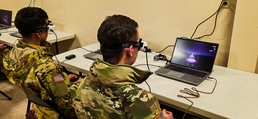
To prepare soldiers, the division is launching a simulation-based training program. “There will be simulation computers with high-end graphics and processors tied to FPV racing-style games,” Roper explained. “It is extremely important to get a large number of hours on the simulations prior to flying FPV-style sUAS.”
The initiative represents a significant step in adapting military technology for the unique demands of Arctic warfare, with the lessons learned expected to influence the Army’s broader strategy for using sUAS in extreme climates.