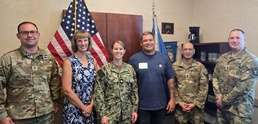
When recruiters arrive at Spokane MEPS for chief medical officer Dr. Victoria Weaver’s Immersive Recruiter Experience (IRE), they don’t come as observers or guests, they come as applicants. Civilian clothes, a name tag and a place in line.
From the waiting room to the medical brief, vision testing and interviews, recruiters experience MEPS exactly as their applicants do.
“The process of applying DoD standards is complex and constantly evolving,” said Army Capt. Patrick DuBoyce, Spokane MEPS executive officer. “Left unaddressed, misunderstandings and communication barriers fester and degrade the relationships at the core of their mission. How can USMEPCOM proactively improve mutual understanding and strengthen these critical relationships? Dr. Weaver says to roll out the Red-Carpet Treatment and immerse recruiters in the same MEPS experience as their recruits.”
The goal is to improve preparation and reinforce that recruiting and USMEPCOM are not separate missions, but teammates working toward the same end state.
“I don’t see recruiting and USMEPCOM as standalone missions,” said Weaver. “I view the recruiting mission, the MEPS mission and the training mission as missions within a mission. We are all teammates with a common goal.”
Weaver developed the IRE to bring in recruiters who may have processed through a MEPS themselves before USMEPCOM rolled out its Red Carpet Treatment program for applicants.
“Most recruiters were preparing applicants based on what MEPS was like years ago,” Weaver said. “The best way to know what the experience is like now is to have it yourself.”
Inspired by a former commander who once processed as an undercover applicant, Weaver partnered with Spokane MEPS Army service liaison Sgt. 1st Class Brandon Jones to turn the concept into a structured program.
Through IRE, recruiters process as prior-service applicants, completing mock medical history forms, sitting through briefs, observing medical operations and engaging directly with MEPS staff without leaving any permanent footprint in official systems. Recruiters are not allowed to participate if they or their station has an applicant on the medical floor.
According to Navy Cmdr. Kelly Agha, Spokane MEPS commander, the experience directly improves how recruiters prepare applicants long before they arrive at MEPS.
“The immersive recruiter experience allows recruiters to set up their applicants for success,” Agha said. “If they understand the process better, they can manage expectations, complete paperwork more accurately and reduce the timeline between contact to contract.”
Recruiters who have completed the experience return to their stations with a clearer understanding of why accuracy and preparation matter. The biggest takeaways by recruiters thus far have been the importance of quality medical screening in their stations and working cooperatively with the MEPS regarding projections and scheduling.
“I was given the opportunity to participate in the IRE at Spokane MEPS,” said Army Sgt. 1st Class Derek Dittmer. “The medical history review was very straightforward and even having done hundreds of forms with applicants, I found myself with a couple epiphanies of my own… By taking the weeks of our mission month into consideration, we will now be avoiding sending a process authorized applicant in the last two weeks with complex medical history and less likely to produce a contract within the same day or week. This will give the medical department at the MEPS time to truly perform prescreens, medical history reviews and focused exams for applicants with a likelihood of enlisting on the floor that day, instead of burning the doctors’ hours during critical weeks.”
At its core, IRE is about trust and breaking down long-standing misconceptions on both sides. By allowing recruiters to see the pace, workload and complexity of MEPS operations firsthand, the program replaces assumptions with understanding.
“This program fosters trust, transparency, and rapport between recruiters and MEPS staff,” Agha said. “As one cohesive team of trusted professionals, we share the same goal: to deliver highly qualified service members as part of the All-Volunteer Force who will strengthen the most capable and lethal fighting force in the world.”
After early success in Spokane, Western Sector leadership approved expanding the pilot to additional locations to test its scalability. Seattle MEPS was selected as a medium site and San Diego MEPS as a large site.
“Spokane is a smaller MEPS,” Weaver said. “The question was, would this work in a medium or large MEPS with higher volume?”
For Weaver, the expanding IRE is about more than improving processes. It’s about changing mindsets.
“We’re like a relay team,” Weaver said. “Recruiters start the race, we carry the baton together and then we hand off a qualified recruit to our anchor leg at the IET site. If we act like silos, we get in each other’s way.”
That relay has become a true partnership. One that has already shown improvements on how a recruiter’s applicants arrive to the MEPS after they have been an IRE “applicant” themselves.
“This allows recruiters to give their applicants a better brief,” said Weaver. “That gives the applicant a much more relaxed experience. That Red-Carpet experience is what we strive for.”