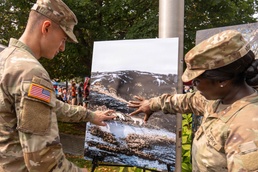
The Natick Soldier Systems Center (NSSC) brought science, technology and a people-first mission to the community during Natick Days, held Sept. 6 in downtown Natick. The annual event, designed to highlight local organizations and foster connections with residents, provided NSSC with an opportunity to show how Army research at Natick directly supports Soldiers in the field — and benefits the public as well.
The DEVCOM Soldier Center featured the largest footprint of the day, with displays ranging from advanced food technology to camouflage science, and even a tactical vehicle that drew attention from families as they walked through the town square. Scientists explained how these innovations tie into the Army’s broader effort to ensure readiness.
“At Natick Days, we were able to showcase a wide range of ration platforms that are currently fielded including the Meal-Ready-to-Eat (MRE), Meal-Cold-Weather (MCW), First Strike Ration (FSR) which is transitioning to the Close Combat Assault Ration (CCAR), Modular Operational Ration Enhancement pack (MORE), and Tube Foods,” said Gil Cohen, a food technologist with the Combat Feeding Division at Soldier Center. “Each ration platform is methodically designed to meet the unique needs of Soldiers in the field – whether it is high altitude, extreme weather, etc. we are committed to sustaining the warfighter.”
Cohen said sharing the work with the local community “allows us to maintain a strong connection and build understanding. Many people are unaware of all the research that is done here at NSSC and how much it influences industry as a whole. By engaging with the local community, we inform locals about some science and technology that supports Soldiers. For me personally, it is always exciting to see reactions when people hear I am on the team of scientists that actually develops food products for soldiers. So many people are unaware that this job exists!”
She added that community members are often surprised to learn about the complexity of military food research. “It is especially important to showcase this work to the public so that they can better understand the complexity of designing food that is nutritious, low weight/low volume, has extended shelf-life requirements, etc. Transporting food and equipment is a logistical challenge – we have to keep this in mind when developing products,” Cohen said.
Col. Sharon L. Rosser, commander of the U.S. Army Research Institute of Environmental Medicine (USARIEM), said her team’s presence at Natick Days allowed them to highlight the “skin-in” side of Soldier readiness. “Military readiness isn’t only equipment and tactics, it includes the critical component of Soldier readiness, or ‘skin-in’ aspects – the health, performance, and physiology of our Soldiers,” Rosser said.
She emphasized the value of explaining USARIEM’s mission to the community. “Sharing our work allows the public to understand the comprehensive approach needed to ensure our Soldiers are at their best, both physically and mentally,” Rosser said.
Rosser also said community engagement demonstrates responsible stewardship. “By sharing USARIEM’s positive impact on Soldier health and performance, we demonstrate responsible stewardship of public resources. Transparency builds trust and fosters continued support for military research. It also gives us a chance to inspire others to optimize their health.”
Both Soldier Center and USARIEM highlighted how their complementary missions come together. Rosser described it as the “skin-in” and “skin-out” approach. “The ‘skin-in’ and ‘skin-out’ analogy illustrates how DEVCOM Soldier Center (SC) and USARIEM, respectively, collaborate to holistically support our Soldiers,” Rosser said. “DEVCOM SC focuses on the ‘skin-out’ – the equipment, uniforms, and technologies that Soldiers interact with in the field. They are concerned with the external factors that impact a Soldier's ability to perform their duties, like protection from the elements, improved load carriage, and enhanced communication systems. USARIEM, on the other hand, concentrates on the ‘skin-in’ – the human element itself: the physiology, health, nutrition, and cognitive performance of the Soldier. The Soldier, equipment and tactics aren't mutually exclusive; they are deeply intertwined and fundamentally complementary.”
For Rosser, events like Natick Days strengthen the Army’s connection to its neighbors. “USARIEM is a part of the broader community and engaging in community strengthens the bond between military and our local community we serve. We are also able to inspire the next generation of civilian and military scientists and leaders by sharing what we do and the Summer GEMS program we offer for the young people who want to pursue careers in STEM fields,” she said.
She added: “I hope the combined presence of science, research, and garrison support allows the community members to see that the Army is a forward-thinking, people-centric organization deeply committed to its Soldiers, their families, and the communities it serves. That they see an Army that is modern, innovative, and compassionate and that is dedicated to protecting our Nation while also investing in the well-being of its most valuable asset: its people.”
Cohen agreed that the community presence makes a lasting impact. “We have a shared purpose. We are a team that has a wide range of expertise. By participating in this event, we humanize our work and are able to showcase physical items to the community,” she said.