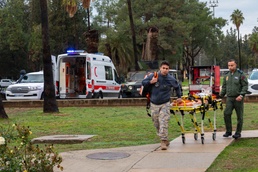
INCIRLIK AIR BASE, Türkiye -- The 39th Air Base Wing exercised its natural disaster response capabilities as part of Titan Dawn 26-02 Jan. 13-14, 2026. The exercise simulated an earthquake impacting the base and surrounding area with conditions similar to the 2023 earthquake in Türkiye, where Incirlik acted as a hub for humanitarian aid in the region.
“Titan Dawn 26-02 was designed to test our wing’s ability to quickly recover the base after a natural disaster and get it back to mission ready” said U.S. Air Force Maj. Kyle Rich, 39th ABW director of operations. “We’re stressing our wing’s ability to maintain command and control in a communications degraded environment, assess and respond to damages to critical infrastructure, as well as respond to a mass casualty event including U.S. and NATO partners.”
For the first time in the base’s recent history Incirlik’s Turkish and Spanish military members were integrated in the planning, coordination and execution of a large-scale wing-level exercise. Members from both countries were integrated into the emergency operations center as well as the mass casualty scenario.
“As the Spanish contingent deployed on an international mission, it’s a great challenge to take part in an exercise carried out mostly by the U.S. Air Force,” said Spanish Army Sargento Primero Marduk Navarro Carmona. “We mainly played the roles of earthquake victims, but also our Medical Spaniard platoon supported with triage tasks. Our participation added the language barrier element, increasing the difficulty in interacting with patients as well as medical teams. The exercise was very complex and despite the challenges, the exercise was well executed by all units.”
Exercises like Titan Dawn deliberately place Airmen in high stress training scenarios where skills are tested and refined through practice while working alongside our Turkish and Spanish counterparts. U.S., Turkish and Spanish medical teams worked together to respond to a simulated mass casualty event where they worked hand and hand providing lifesaving care to over 70 patients. Facing these challenges together fosters professional growth, sharpens tactical execution, and reinforces the teamwork and resilience required in crisis scenarios.
“This Titan Dawn increased casualties from the normal exercise max of 14 to 74, which is the largest number this base has seen in over 10 years,” said U.S. Air Force 1st Lt. Amanda Deveaux, 39th MDG Medical Readiness Flight commander. “This also helped us assess our capabilities and stress our resources to depletion to identify necessary equipment and supplies for future training, exercises, and potential real-world events.”
The exercise replicated real-world conditions by reinforcing mission-relevant training such as validating equipment and supply management as well as managing 24-hour operations under stress and fatigue. In addition to the mass casualty event, Airmen had to navigate challenges such as verifying accountability with degraded communications, and working through the management of resources such as food and water. All those challenges were approached not just from a U.S. perspective, but taking the entire base population, including the Turkish, Spanish and Polish military community into account.
“Without testing our operational cohesion with our NATO partners, it’s hard to be ready for any crisis or contingency we will face in the future.” Rich continues. “Our wing’s intent is to build onto this momentum for future exercises by involving our partners in as many wing-level exercises as possible.”
*Editor’s Note: some parts of this article were translated to English