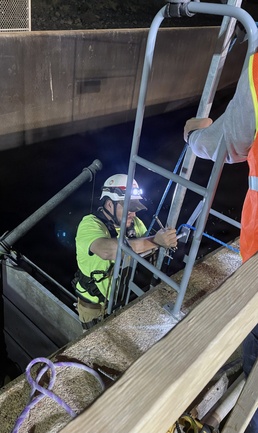
MONCURE, N.C. — The U.S. Army Corps of Engineers Wilmington District recently completed a comprehensive inspection of the outlet conduit at B. Everett Jordan Dam, confirming that the structure shows no excessive degradation and all findings remain within safe operating margins. The inspection included crack mapping, joint evaluations and advanced ground-penetrating radar scans to assess both the concrete conduit and the surrounding soil conditions. “This conduit is more than 50 years old and it continuously carries large volumes of water,” said James Duke, project manager, U.S. Army Corps of Engineers Wilmington District. “Over time, that constant flow can slowly degrade the concrete. Getting inside the conduit allows us to make sure that degradation is not reaching a point that would affect dam safety.” The outlet conduit serves as the primary pathway for regulating water released from Jordan Lake. Duke said maintaining its structural integrity is critical to protecting downstream communities. “If the conduit were to fail, it could lead to a partial collapse and potentially a full dam failure,” Duke said. “That would affect water levels, water supply and recreational access across the region.” Engineers and geologists documented existing cracks and compared measurements with data collected during a previous inspection. Duke said preliminary results showed all conditions were within expected and safe margins. The team also conducted geophysical scanning to identify any potential voids in the soil surrounding the conduit — an issue flagged during earlier inspections. “These scans allow us to see what the naked eye cannot,” Duke said. “ In the coming weeks after the data has been fully processed we will have a much better understanding of what the soil conditions are like beyond the walls of the structure.” Geophysical work was supported by the U.S. Army Corps of Engineers Geophysics Community of Practice, a nationwide network of geophysical specialists who provide advanced technical support to districts. In addition to conduit inspections, the team examined massive steel service gates used to control water releases — some of which had not been physically accessed in several years. Duke credited the successful and early completion of the inspection to close coordination among multiple teams. “There were a lot of unknowns and unforeseen challenges,” Duke said. “But our engineers, repair yard staff, rangers and the Geophysics Community of Practice adapted at every step, allowing us to complete the inspection a full shift ahead of schedule.” Data collected during the inspection will be used to inform long-term maintenance planning. Duke said no repairs are currently anticipated based on preliminary findings. “This work is part of our ongoing responsibility to inspect and assess these structures every five years to ensure they remain safe for continued use and for the protection of the public,” Duke said.