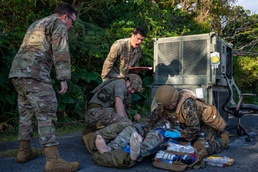
KADENA AIR BASE, Japan – In the Indo-Pacific, where distance and logistics can challenge medical response times, U.S. service members are training to bring lifesaving care wherever the mission takes them.
The 18th Medical Group hosted Project Valkyrie, a joint-service medical training course focused on emergency blood transfusion procedures, at Kadena Air Base, Japan, Nov. 30, 2025.
The week-long course teaches military medical personnel how to safely collect and transfuse fresh whole blood in austere or resource-limited environments; a critical skill when time and resupply are limited.
“This training is crucial for our medics when they’re put in high stress environments where resources can be limited,” said U.S. Air Force 1st Lt. Darreauna Morris, 18th Medical Operations Squadron Project Valkyrie program manager. “It gives students the confidence and competence to perform these procedures when it matters most.”
Project Valkyrie blends classroom instruction with hands-on simulations, allowing trainees to perform emergency blood transfusions under realistic conditions. Each course culminates in tactical combat casualty care scenarios where participants apply their skills under pressure.
For this iteration, participants included medical personnel from the 18th MDG, 961st Airborne Air Control Squadron, Misawa Air Base’s 35th Medical Group at Misawa Air Base, U.S. Army 1-1 Air Defense Artillery, and the U.S. Marine Corps 3rd Medical Battalion.
The joint training provided a shared baseline for emergency transfusion procedures and enhanced coordination across services. By learning each other’s terminology, methods, and capabilities, the teams improved their ability to operate as one cohesive medical force.
“Each service approaches medical care differently based on their mission sets,” said U.S. Air Force Capt. Brittany King, 18th Medical Operations Squadron Project Valkyrie medical director. “Training together helps us learn each other’s language so we can operate more effectively as a joint force.”
In the Pacific theater, where vast distances, can delay access to traditional medical supplies, fresh whole blood transfusion is a proven life-saving measure for those suffering from hemorrhagic shock, the leading preventable cause of death in combat.
Project Valkyrie ensures that when emergencies happen far from hospitals or supply chains, medics are ready to respond decisively. The program not only sharpens clinical proficiency but also strengthens joint medical readiness across the Indo-Pacific.
“This course builds the confidence and interoperability we need in real-world scenarios,” Morris said. “No matter the location or the service uniform, everyone here is focused on the same goal: saving lives.”