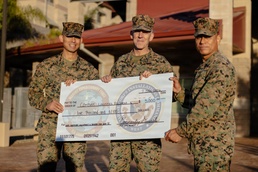
MARINE CORPS BASE CAMP PENDLETON, Calif. - U.S. Marines with Combat Logistics Regiment 1, 1st Marine Logistics Group, were awarded a $5,000 check on Jan. 7, 2026, for their efforts during Operation Clean Sweep III, conducted Sept. 22-23, 2025. The event marked the second time that a unit within 1st MLG has been recognized for their efforts during OCS with a check.
OCS III focused primarily on sustaining and reinforcing barracks and common-area improvements achieved during the previous iteration, ensuring those enhancements were maintained over time. “It’s not just a field day or just cleaning the barracks,” said Maj. Ryan Dick, a logistics officer with CLR1, 1st MLG. “It’s trying to get Marines to have ownership over their living space, and at the same time bringing in leadership.” Dick explained that this iteration of OCS emphasized small-unit leadership, allowing noncommissioned officers to lead planning and execution at the ground level to preserve and build upon earlier gains.
“When we started, I wasn’t sure what the best way to organize everything was,” Dick said. “After talking with the NCOs, they came up with the idea to organize into teams and task-organize by specific areas. That really stepped it up.”
The efforts of small-unit leaders were formally recognized during an award ceremony by Lt. Gen. Wortman, the commanding general of I Marine Expeditionary Force. Lance Cpl. Daniel Rodriguez, a finance technician, and Sgt. Asaint Sinclair, an electrician, both with CLR-1,1st MLG were recognized for their leadership and contributions to the success of OCS III.
Throughout OCS III Rodriguez acted as the facilities lead and work order manager. He streamlined maintenance operations, documented outstanding work orders, distributed self-help materials, and ensured up-to-date records. Sinclair acted as the platoon sergeant for OCS III. He maintained accountability for over 85 Marines, organizing them into eight teams to achieve the highest effectiveness during the two-day event.
Building on lessons learned from earlier iterations, CLR-1 focused heavily on planning for OCS III. “We ordered materials well in advance, sent Marines to barracks management classes, and held town halls to gather ideas,” Dick said. “That planning made a huge difference.” Leadership tracked progress from previous OCS events, establishing a battle rhythm to follow up on discrepancies and ensure improvements were sustained over time.
The effort resulted in the completion of 153 self-help projects, including patching drywall, replacing window screens, fixing dozens of light fixtures and outlet covers, repairing potholes, and pressure washing common areas. Marines also validated room occupancy, reconciled maintenance work orders, annotated missing and damaged fire extinguishers, and shut off gas lines to unsafe grills.
“Marines like Sgt. Sinclair absolutely took ownership,” Dick said. “He told his team, ‘This is what we’re going to do, and this is how we’re going to do it.’”
In addition to routine maintenance, and cleaning, Marines prepared barracks rooms and furniture for Marines returning from six-months in Australia with Marine Rotational Force–Darwin. Damaged mattresses and furniture were removed and replaced to ensure safe and habitable living conditions upon their return. Work extended beyond the barracks into CLR-1 workspaces, where Marines cleared walkways, removed invasive plants, overflowing trash, and dunnage. Approximately eight truckloads of material were disposed of during the event.
More than 100 units across Marine Corps Base Camp Pendleton and I MEF participated in OCS III. Units from 1st MLG have won every iteration of the competition, continuing a standard of excellence established by the previous winners, 7th Engineer Support Battalion, 1st MLG.
The effects of OCS III are evident across the unit. Improved living conditions directly support Marines’ ability to recover after exercises and deployments, contributing to increased morale and operational readiness. “The real change wasn't just patching drywall or replacing lights,” said Dick. “It was seeing the Marines learn how to make those fixes themselves and take pride in the results. We held town halls, listened to their concerns, and gave them the tools to solve problems. That empowerment has been the most significant impact, and it’s built to last.”