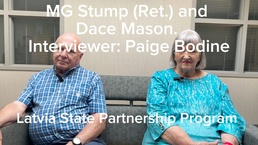
GEN STUMP 00:00:06
Errol Gordon Stump, I was the adjutant general at the time that we started a state partnership program back in 1993.
DACE MASON 00:00:17
I'm Dace Mason.
DACE MASON 00:00:20
And I worked for General Stump. I worked for four adjutant generals.
DACE MASON 00:00:27
And I am now retired.
GEN STUMP 00:00:32
Let's start with General Conaway from the National Guard Bureau. Uh, made a trip to the Baltic countries, Latvia, Lithuania, and Estonia. And the uh, it was the end of the uh, Soviet Union. And we wanted American participation.
GEN STUMP 00:00:52
And the Soviet Union's military released the new countries that were now independent of it.
GEN STUMP 00:01:01
And it was General Conaway's idea that the best way to do that, and not to have a problem with the Russians, was to get the National Guard involved.
GEN STUMP 00:01:14
So he went to the Baltic countries.
GEN STUMP 00:01:18
Proposed having the military get the militaries in these countries. Uh, partnering with the National Guard because it was a homegrown force and something the Soviets wouldn't feel threatened by. We weren't moving in, obviously, with the active duty military.
GEN STUMP 00:01:42
And taking over the countries or being a threat to Russia. So he came up with this program. Why don't we just have the uh National Guard help the countries? And so he went in and talked to the presidents of the Baltic countries and said, 'How about if we partner up with the National Guard in the States?
GEN STUMP 00:02:09
To give them some idea of how the military would operate and what help we can provide to these different countries. Because, for instance, Latvia was wholly taken over by the Russians during this time. And they ran the middle there. Are many Lafayettes in the Russian army, and the Russian military did not meet any kind of standards that we have here in the United States.' So we needed someone who would work with the military in the Baltic countries so they could move forward from where they were under Russian rule.
Interviewer 00:02:52
All right, from your foxhole.
Interviewer 00:02:55
Take me back to the beginning, as this was starting to happen.
Dace Mason 00:03:02
It was very surreal when General Stump started talking about it because I am of Latvian heritage. I was born in a displaced persons camp in Germany. When my parents were coming, they had escaped from Latvia and were coming to the United States, which was never their intention. They just left Latvia. When it was invaded, the Russians forced them out.
Dace Mason 00:03:30
And then they always thought that they would go back. But in fact, we're not able to because of the occupation.
Dace Mason 00:03:38
It was an extraordinary thing to think that the National Guard would be partnering with Latvia.
Interviewer 00:03:50
That's awesome. And then Dace, if you want to. It starts with this next one, then we can move to general stone, but Oh. Why Latvia? What made it the right fit for Michigan?
DACE MASON 00:04:05
Well, there were a lot of Latvians in Michigan.
DACE MASON 00:04:09
General Stump also had a friend with whom he had worked, who was Latvian. I was Latvian, so all of these kinds of coincidences.
DACE MASON 00:04:21
Work together. And he was able to pick Latvia and was utterly thrilled by it.
Interviewer 00:04:37
That's awesome. Can you add to that? Why Latvia ended up being that number one pick for you guys?
GEN Stump 00:04:46
When we first heard about it, we heard that they were starting with the Baltic countries, Latvia, Lithuania, and Estonia. And a good friend of mine, Andy Lazes, and his wife have a computer company that works out of Latvia, and of course, Dotsie was Latvian too, and she knew all about Latvian people living in Michigan and said, 'This is a perfect fit for us.' Especially for the Michigan National Guard, given our existing connections. With Lafayette. It made sense that you partner with somebody when you have a large Latvian population here in the state of Michigan.
Interviewer 00:05:30
Okay.
Interviewer 00:05:31
So, as you guys kind of realize, okay, we're gonna move with Latvia, um, what was one of those first steps that moved this idea? Okay, let's go through a state partnership with them, into action.
GEN Stump 00:05:47
Well, we got a message from the Guard Bureau that they were looking for partners for the Baltic countries, Estonia, Latvia, and Lithuania. And. So we decided that Latvia was the country he wanted, called and asked to be a Lafayette partner, and said, 'Fine,' but send us some information on what kind of program you would have for them. So we had to let it curl off. Ever. Who was there?
Gen Stump 00:06:17
Wow. A Michigan National Guard person. And I talked to him, and I said, 'Listen, I need you to put together a program on how we can work with Lafayette to help them become a viable law military.
Gen Stump 00:06:34
And we need a formal program that I can take to the National Guard Bureau and request that they pick Michigan as our partner.
Interviewer 00:06:48
Dace, as this was coming into play, was there anyone you had to call right away in Latvia?
DACE MASON 00:06:55
Mostly my parents, who were just beside themselves.
DACE MASON 00:07:01
Also a little concerned because Latvia was so newly freed.
DACE MASON 00:07:08
And they had had such a terrible experience with the Russians and the communists that came in, but mostly just completely threw them.
Interviewer 00:07:19
Thank you.
Interviewer 00:07:21
Um, so as you guys started this partnership program, obviously the first one in America, what were some early challenges that you guys ran into as this thing started?
GEN Stump 00:07:35
Well, we had a language barrier with the Latvians. And we had three. Michigan National Guard soldiers who spoke fluently. Uh. Latvian. So that was a heads-up for us, and of course, I had Dotsie here. To help with that too. So there was a language barrier in the beginning. And uh. We didn't. Understand where the military was in Latvia. So, we wanted to. You know, I have fun. In fact, finally, the State Department said, 'Okay, we're going to try this program.' And that was in April of 73.
GEN Stump 00:08:19
And so that summer, we decided to go to Latvia, and I took Dace as my interpreter, and we went to Latvia to meet with the Latvians and the Russians, because there were still 40,000 Russians in Latvia. But a few military people who had been in the Russian army were in command positions, but they didn't have any influence on what was going on. So we actually traveled to Lafayette. In July of 93, to discuss the state partnership program with them.
Interviewer 00:09:05
So, Dace, walk me through this. So you were almost a translator when the program started.
DACE MASON 00:09:12
The first trip over was terrific, you know, when I first stepped off the plane to actually be in Latvia.
DACE MASON 00:09:21
Because I never thought Latvia would be free again or that I would ever go there.
DACE MASON 00:09:29
And it was just that Latvians are a very tight-knit community. Ee had a Latvian church. We did Latvian school on Saturday mornings through the church. We had Latvian summer camps.
DACE MASON 00:09:45
Our whole community was tight-knit. My family was very involved in the Latvian community.
DACE MASON 00:09:55
And so, to actually be there after hearing about it for so long was just totally amazing.
Interviewer 00:10:03
That's awesome.
Interviewer 00:10:05
How did the translation go when you were working with, you know, Michigan and being that middle person to kind of help the language barrier?
DACE MASON 00:10:13
Hopefully well, hopefully well.
DACE MASON 00:10:17
My Latvian may have been a little rusty, but you pick it up once you're there for a day. You've got it all back again. I always spoke Latvian at home with my parents.
DACE MASON 00:10:32
My grandmother, who came over with us, never spoke English.
DACE MASON 00:10:36
So I definitely spoke Latvian a lot.
DACE MASON 00:10:40
And there were some military terms that I wasn't familiar with because we never used them.
DACE MASON 00:10:49
And so that was at times a bit tricky. But one of the Latvians who was in the guard actually created a dictionary of military terms, translated from English to Latvian.
Interviewer 00:11:06
Were you nervous?
DACE MASON 00:11:08
Oh, beyond nervous, yes. When you walked into that? Yep.
Interviewer 00:11:11
Wow, so it took a lot of courage, almost. You're like, okay, I'm going to be the secretary, but I'll also be the translator. That's awesome.
DACE MASON 00:11:25
And then, as an aside, where we stayed was in a uh, a resort.
DACE MASON 00:11:35
It was on the Baltic Sea. That was kind of the place where all of the Russian hierarchy staged, so that was kind of the best of the best.
Interviewer 00:11:48
And it kind of made you see how?
DACE MASON 00:11:52
Almost backward they were. I mean, the facilities that they had just didn't compare at all with what we had here in the States.
DACE MASON 00:12:00
You know, the telephones are very antique looking and everything like that. That was just so interesting to me.
Interviewer 00:12:09
When you say 'backwards,' what do you mean by that?
DACE MASON 00:12:12
Um, just not as sophisticated as what we had, not as uh technologically advanced, perhaps. And I don't know, it just struck me that this was the best hotel.
DACE MASON 00:12:26
And it would not have been by U. S. standards.
Interviewer 00:12:34
So, could you talk a little bit about how, when this all started, how did you start to build trust with Latvian counterparts?
Interviewer 00:12:44
I know Dace kind of talked about there's a lot of uncertainty when it first started.
GEN Stump 00:12:49
Well, we met with plenty of the hierarchy in the Latvian military.
GEN Stump 00:13:04
We met with a colonel in the Russian army who was kind of the military leader for Latvia at the time. We had a formal meeting, went through a meet-and-greet, and went through a line to shake hands with him. It was interesting. I brought my wife with me, and he wouldn't shake her hand; he was annoyed she was here. That was the way the Russians were. Because there were still 40,000 Russians in there. In the meantime, I started talking to the people who were beginning to take over.
GEN STUMP 00:13:40
We met with the leader of the National Guard of Latvia. And they called him the Zemezard. And I met with him and discussed what they had. And they had small National Guard units throughout the country.
GEN STUMP 00:13:56
But they didn't have much. They were just patriots. He wanted to be in the National Guard. So we met with him and discussed how they were organized, how we were organized, and how we could work together. To show them how the Michigan National Guard operated and get them up to speed, because they didn't even have uniforms at the time.
GEN STUMP 00:14:29
Just that the the Latvians that had fought for the freedom of Latvia. And those were the Graube— was one of them. And those were the ones that actually barricaded on the bridges.
DACE MASON 00:14:49
They were very receptive and very grateful. That they were.
DACE MASON 00:14:57
And I think they were thilled. Thrilled to work with General Stump and to learn more about how we do things and what they may think about doing.
Interviewer 00:15:08
Thank you. Um, can you share a personal story or a moment from those early days when you first got there?
DACE MASON 00:15:18
You saw those that really captures the spirit of the partnership— just how gracious they were and how giving they were.
DACE MASON 00:15:32
I think I told the story before about Um.
DACE MASON 00:15:38
Jim McCrone (PAO OFFICER) here, who went over and worked with their public affairs people.
DACE MASON 00:15:45
And he had looked out the window, and they were siphoning gas out of their personal cars to fill one car so that they could take him around. Because they just didn't have the resources.
DACE MASON 00:16:02
And so they were very, very kind and we were always treated so beautifully and graciously.
DACE MASON 00:16:11
It was just wonderful to be working with them.
GEN STUMP 00:16:25
Yes, it was interesting because many of the Latvians had served in the Russian army. and uh, they were conscripts, um, and I a Russian pilot who flew.
GEN STUMP 00:16:41
And we got to talk about stories. And he was flying planes in North Vietnam. In South Vietnam, it was kind of interesting. We were still flying in the same skies, on different sides of the war. And then I met an army guy who was working on the Russian side. And uh in North Vietnam. And he said that he was working and all of a sudden, you came over, and you dropped some uh some pamphlets that said, if there are any Russians here, you better leave, because we're going to bomb this site tomorrow. And he said, we laughed. He said, who would be so stupid as to send an airplane over and drop a pamphlet?
GEN STUMP 00:17:42
I said, what happened? He says, you bombed it. And I said, what did you do then? He says, I left. Didn't come back, so that was kind of interesting, because we were actually talking to the Russian soldiers who were. were serving in Vietnam when I was at the same time. And it was really interesting.
GEN STUMP 00:18:00
And they were back home in Latvia, having served in the Russian army in Vietnam.
Interviewer 00:18:12
What impact, when you're thinking back, of when we actually had soldiers start to interact with Latvian service members? What impact did those first exchanges or exercises have on the Michigan National Guard soldiers?
GEN STUMP 00:18:28
I think it was a very positive impact. It was another way to look at what was happening during the Cold War and see where the Latvians were, and they weren't very far along. As far as the military and so forth. It was an eye-opening event for them. To get over and see this is what the real Cold War was like. And then working with them was an educational experience for them. As it was for the Latvians when they came over here and they said, 'Wow.' This is what it's like to be in the National Guard. Of course, we had armories and equipment. All that sort of thing. So it was an eye-opening experience for both the Latvians and for the Michigan National Guard.
DACE 00:19:16
I think that all of the soldiers that went, you never had to try to find somebody to go. Everybody wanted to go. And it was a wonderful experience for them. They came back and they were collecting uniforms.
DACE MASON 00:19:32
To send back there to give to the soldiers who didn't have them.
DACE MASON 00:19:38
And they also commented on how well well treated they were treated. and they got a chance to see the facilities, which were, you know, basic at best.
DACE MASON 00:19:52
and I think got to appreciate more what they had here.
Interviewer 00:19:56
Okay, awesome.
Interviewer 00:19:59
Sir, looking back, what surprises you most about how the relationship developed?
GEN STUMP 00:20:07
Well, well, they, at the time they started from nothing, I mean they had nothing and they, they had a, they had a, uh, an organization.
GEN STUMP 00:20:18
That the Russians had. The Russians don't use Non-commissioned officers. And then, for them, after a number of years, to not only become organized the way the US military was. But then, in the very end, they become members of NATO.
GEN STUMP 00:20:51
And they actually meet NATO's army standards now. Because of the relationship we've had with them and the training that we've gone through with them over the last 25 years.
Interviewer 00:21:03
Dace, from your side of it, what has surprised you the most about how the relationship has developed with Michigan?
DACE MASON 00:21:12
How long-lasting it's been. And that people that were involved in the very beginning still have contact.
DACE MASON 00:21:21
And, you know, it was just such a bond that developed between the people.
GEN STUMP 00:21:33
Sir, what lessons from the early years do you think are still guiding the partnership even today?
GEN STUMP 00:21:42
Well, the trust we have in them and they have in us.
GEN STUMP 00:21:46
We're partners now. We've actually gone to war together in Afghanistan.
GEN STUMP 00:21:54
We're truly partners because they trust us. They don't call the Air Force or the Army, the U. S. Air Force or the Army. They call the Michigan National Guard. “They'll know what to do to help us.” And so we've got a great working relationship. It's one that they're truly, truly partners. Because they've spent a lot of time in Michigan. We had a Michigan people spend time in Latvia. And we have a trust between us. In fact, as I said, we went to war together. In fact, two of the Latvian soldiers and American soldiers were killed. In Afghanistan, but we worked together and actually went to war together.
Interviewer 00:22:46
So, an example of when you received a call from a Latvian hey will you give advice on XYZ?
GEN STUMP 00:22:58
No. We actually have a full-time person ever since we started a partnership that's there. And they coordinate when they really need something.
DACE MASON 00:23:34
Dace, do you have any lessons from the early years that you feel like are still guiding the partnership?
DACE MASON 00:23:42
It was because it was a true partnership. It was not the Michigan National Guard going over there and telling them what to do.
DACE MASON 00:24:10
I think that the true partnership made it work so well.
Interviewer 00:24:18
Looking back, do you guys have any advice for leaders or someone trying to start a similar partnership?
GEN STUMP 00:24:29
I think just what we learned about the partnership portion, not to be lecturing, not to be saying you're doing this wrong. You can't do that. You're doing this wrong. Just leading by example, guiding them. Showing that we're learning from them—I mean, there was a lot of lessons that were learned from them.
DACE MASON 00:25:02
Absolutely not. Not in my wildest dreams. Um, the things I regret were I would have paid more attention in Latvian school as a child rather than wishing I wasn't there and I could be home watching cartoons like my friends.
DACE MASON 00:25:26
But no, I never, never, never imagined it.
Interviewer 00:25:33
Sir, looking back from when you first started your role with the Michigan National Guard, would you have ever expected doing a state partnership program with Latvia? Is that something that surprises you?
GEN STUMP 00:25:47
Oh yeah, no, no, I never, never, never dreamed it would it would happen and when it did and then uh uh, I won't forget meeting the Latvian president.
GEN STUMP 00:26:05
And he was a very gracious man. And he spent three different trips coming to the United States. And I spent three trips visiting him in Latvia when he came over here. In fact, I gave him a ride in an F-16. He still talks about that. He's probably the only president of a country like that who was able to come over here. Go riding an F-16, but we took him there and we showed him all of them. The equipment we had here. And so forth. When I went over there, he was very gracious. He and I even went wild boar hunting.
Interviewer 00:26:43
Oh, wow.
Interviewer 00:26:46
In addition to a partnership, it was almost like a friendship?
GEN STUMP 00:26:49
Oh, yeah, it was, yeah. And sure enough, we went out to hunt wild boar at midnight because it was June.
GEN STUMP 00:27:00
He gave me a guy to go with me. Find the boar, and sure enough, there was a mother and two small boars. And the Latvian guy said, 'No, no, don't shoot the big ones, shoot the little ones.' So I shot the little boar. When we got back, he says, 'Well, how'd you do it?' He says, 'Well, I shot one.' He says, 'Where is it?' I said, 'I don't know.' It's out there somewhere. And so he made the guys go out and find the boar. and bring it back.
GEN STUMP 00:27:40
to show, here's the one, here's the one he shot.
GEN STUMP 00:27:44
later, what happened later on his last trip to to the state. He had some friends in Grand Rapids who he liked to visit. He wanted it to come over. So he was coming over to visit again. And he always told the Secret Service, 'I'm on vacation.
GEN STUMP 00:28:03
don't uh give me any protection or anything. Just leave me alone.' But the last time he didn't do that. So the last time he came over, he was speaking at the United Nations. And he said, 'Okay, I want you to come to my speech to the United Nations. So I went to Washington.
GEN STUMP 00:28:22
I went to the United Nations building and heard his speech. Now, I've got the president of a country who is coming here to the United States, and it didn't matter if it's a little country or a big country, he still gets all of the to protect and custody of a president. So we had a plane that came to pick us up to take us from Washington, D. C. back to Michigan.
GEN STUMP 00:28:51
And he had about 12 boxes full of stuff. And they had three or four Secret Service guys that wanted to go along.' He said, well, there's not room for all the boxes in the Secret Service and you and I. And he said, no, no, important stuff.
GEN STUMP 00:29:07
He said, okay, I’ll have one Secret Service guy go with us. We need to have the rest of the boxes. There were some boxes of beer, Latvian beer, that he brought for his friends over here. And another thing he brought was a big box. Of a wild boar head.
GEN STUMP 00:29:26
And he said, here's the one you shot. I said, no, no, no, it's a not. Mine was a little one. It is not a big one like this. He said, well, they won't know that.
GEN STUMP 00:29:37
This is for you. So he had this big boar. My wife took one look at it. She says, you're not bringing that home.
GEN STUMP 00:29:44
So it's hanging today. In the officers' club at Grayling.
GEN STUMP 00:29:50
National Guard base. Yep. There's this huge boar head.
Interviewer 00:29:53
Now we know the story behind the boar.
GEN STUMP 00:29:55
That's right. Presented to Major General Stump from the President of Latvia .
Interviewer 00:30:00
That's incredible.
GEN STUMP 00:30:09
It was a wonderful program that nobody thought would work. And it was something that was to get around the Russians, that you just bring the National Guard in. They're not a threat.
GEN STUMP 00:30:23
Russia is probably looking on and saying, 'Whoa, wait a minute, they're a threat now because they meet NATO standards and now they've got an air base that's active and so forth.'
GEN STUMP 00:30:35
At that point in time, we needed to get involved with these emerging nations. And to do it through the National Guard was the way to go. And now there are 77 countries that have state partnership throughout the whole United States. And it's an easy way, in a relatively inexpensive way, to form partnerships with some of these countries. After a couple years, there was not much funding. It was very little funding. They only gave us a little bit of of funds to get things going. And so it was kind of slow.
GEN STUMP 00:31:27
The word was, they were going to cut off the funding and stop the partnership program.
GEN STUMP 00:31:31
So I went to Senator Levin. I said, Senator.
GEN STUMP 00:31:36
This is a great program. We can't let it die. I said, we need to get some funding. So he says, okay, I agree. And he put a couple million dollars in for funding to keep it going. And so from then, they started looking at what really was happening in Latvia, Lithuania, Estonia? And they said, well, we need to expand this because this is a relatively inexpensive way for the United States to help these countries.
GEN STUMP 00:32:08
It started, as I said, it began with three countries— Michigan, Latvia, and Estonia. And now there are over 77 countries that we're helping. In fact, Michigan's got Liberia helping them, too, now. But it's an inexpensive way for us to influence these countries and to bring them over to our side.
Interviewer 00:32:30
Dace, do you have any thing to add?
DACE MASON 00:32:36
Just what a fantastic program it did turn out to be. Like General Stump was saying, it is a relatively inexpensive program that builds lasting relationships and goodwill.
Interviewer 00:32:50
And it was so cool to hear that you added so many ties to it. Right, right.
DACE MASON 00:33:05
Yeah, no, it was terrific.
Interviewer 00:33:27
What ties did you have with local leaders?
GEN STUMP 00:33:35
Yeah, we asked local leaders if they would. Would like to visit La Via and learn more about it. And see if there were any business connections they could pursue. And we actually made two trips over. We took local businesspeople to meet with the Chamber of Commerce in Latvia. I did talk to the businesses and laughed and so on. So we had a relationship there between the military and the civilian side.
GEN STUMP 00:34:11
One of them donated. A school bus, uh, for the kids. Dean Transportation.
GEN STUMP 00:34:23
We actually got an airplane. We took a chartered aircraft twice. From Michigan to Latvia with Michigan Businessmen. Business people.
Interviewer 00:34:56
I know this was really long ago, but do you know any of the business names?
GEN STUMP 00:35:06
Well, Freddie Meyer went from Meyers, was one of them, Chris Holman, Holman Businesses, was the other one that was there.
DACE 00:35:37
And Kelly Dean from Dean Transportation donated the bus.
GEN STUMP 00:35:44
Yeah, Dean Transportation.
DACE 00:35:49
And as part of the partnership program's offshoot, we were working with a children's rehabilitation center.
DACE 00:36:02
And that was where the bus went to, to help transport the children to and from their homes to go to the center for daily treatment and schooling, vocational rehabilitation, physical therapy, and that.
DACE 00:36:22
And their roof was in terrible shape.
DACE 00:36:26
And the people just on their own who were on that Civic Leader Tour. Pitched in a bunch of money and re-roofed the building for them.
DACE 00:36:38
And just did a lot of other things to help the rehabilitation.
GEN STUMP 00:36:57
The governor was very supportive. He actually made a trip to Latvia, and he and I were both awarded the honor of three stars from the president of Latvia.