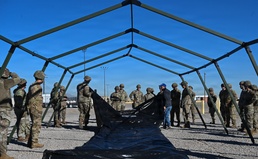
HURLBURT FIELD, Fla. -- During its first field training exercise at Fort Bliss, Dec. 2-16, 2025, the 31st Air Task Force (31 ATF) conducted pathfinding on two fronts critical to the future of Agile Combat Employment, deploying a rapidly mobile headquarters and sustaining mesh radio and network capabilities in a simulated non-permissive threat environment.
The event unified 31 ATF and 31st Combat Air Base Squadron (31 CABS) personnel for 200-level training. Along with exercising core protection and sustainment tasks, 31 ATF proved the viability of tactical and wing operations centers to build and sustain a common operational picture, intuit a battle space, make timely decisions, and communicate effectively without reliance on fixed infrastructure.
"Our concept of employment is a rapidly mobile headquarters which can sense, make sense of, and communicate as a headquarters while defending the airbase," said U.S. Air Force Col. Brad Dvorak, 31 ATF commander. "During this field training exercise, we were able to demonstrate a rapidly deployable wing operations center which can be operational inside of sixty minutes."
ATF members practiced establishing the expeditionary infrastructure designed for speed, flexibility and sustainment, creating scalable facilities to support planning, battle management, and combat communications in contested and degraded environments.
"This flexibility is key to sustaining a distributed command and control with subordinate, lateral, and upper-echelon operational commands," said Dvorak.
During the FTX's 24-hour capstone event, 31 ATF also employed mobile mesh-networking technology which generated self-perpetuating radio and data nodes co-located with small, multi-functional, forward deployed and contingency located teams.
The nimble, distributed network dynamically synchronized voice, data, and situational understanding across dispersed nodes, routing information to a tactical operations center, while mitigating line-of-sight limitations and dependency on third-party systems. The effect was a shared common operating picture and improved cognizance of the friendly order of battle between 31 CABS and 31 ATF leadership.
"During this exercise, Airmen across sixty AFSCs were able to build their command infrastructure, employ a command and control node across a mesh-network via secure and unclassified channels, and redeploy the headquarters in short order," said the ATF commander. "In future exercises, we will partner with mission generation force elements to build, teach, and lead through agile combat employment concepts, providing combatant commanders an air domain awareness capability."
The 31st Air Task Force is an O-6 wing headquarters consisting of a command and control element, supporting a combat air base squadron with up to 2,500 Airmen capable of providing base operating support and supporting up to three mission generation force elements required to execute agile combat employment at any deployed location.