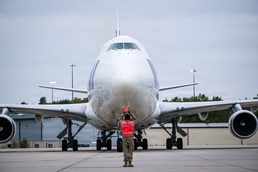
Members of the 721st Aircraft Maintenance Squadron have recently added Commercial Concurrent Servicing to a growing list of unique specializations required to support Rapid Global Mobility across the En-Route System.
The 721st AMXS along with the 721st Aerial Port Squadron support a heavy mission rate with more than 50 aircraft coming through Ramstein Air Base, Germany every day. Completing port and maintenance actions is even more complicated with several daily flights being civilian aircraft and not the C-5M Super Galaxy and C-17 Globemaster III aircraft they are most often trained on. Despite these challenges, the 721st AMXS and 721st APS have implemented a way to minimize ground time for these civilian aircraft, avoiding a snowball effect where crews lose duty hours, resulting in missed time slots, or even delaying mission departure anywhere from a few hours to overnight.
Concurrent Servicing (CS) allows aircraft refueling to be completed simultaneously with any number of necessary port activities, a practice which enhances the ability of the 721st AMXS and 721st APS to process personnel and cargo more efficiently.
“We are able to load or download cargo, do lavatory servicing, refill potable water, or anything else that the APS needs to do while refueling, even with passengers onboard,” said Staff Sgt. Ty Henderson, a 721st AMXS fuel systems craftsman.
However, there are risks associated with concurrent servicing due to the increased activity and movement around the aircraft during refueling operations. But diligent training implementation has been effective in mitigating these risks.
“Since we’re introducing aircraft fuel, there is a increased risk of injury, aircraft damage or mishaps as well as increased risk of fuel spill, fire and explosion due to electrostatic hazards.” Said Maj Alexander Barden, 721st AMXS director of operations, “We coordinate with the Fire Department as well to be on standby to respond.”
To minimize this risk, a concurrent servicing supervisor (CSS) is present while overseeing all operations. This responsibility is specifically monitoring the Fuel Servicing Safety Zone (FSSZ), an area within 50 feet of a pressurized fuel truck. The concurrent servicing supervisor closely monitors all operations as well as control the entry and exit of all personnel, equipment, and vehicles into the FSSZ.
“If I see something outside our risk tolerance or if anybody else does, I am the final say on if the refueling continues or if we pause until the area is clear,” said Henderson.
This level of responsibility requires deliberate training and the 721st AMXS has found a training solution that helped get the program off the ground quickly.
“Training and certification for someone to become a CSS requires at least one year of airframe experience as well as study and review of the applicable tech data, familiarization with working with Petroleum, Oil and Lubricant personnel and other operations during CS,” said Barden. “What makes commercial CS unique is that despite none of our maintainers having airframe experience, we’ve been able to step in fairly quickly to familiarize ourselves with commercial aircraft operations to cut down ground time immensely.”
While implementing the commercial CS program back in October, the 721st AMXS and 721st APS aimed to standardize the process and implement best practices from other installations but quickly discovered that it is an uncommon practice.
“As we were standing up the capability, we reached out to other installations and commercial airports and found that it isn’t something actually done for the most part,” said Barden. “In other words, we’re unique in both the en-route and the Department of the Air Force at large in that we actually do it.”
As the program continues, the 721st AMXS looks to expand the number of concurrent servicing supervisors to grow this capability that they provide in support of the larger Rapid Global Mobility mission.