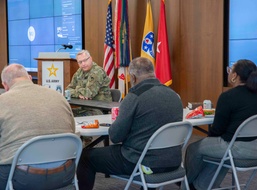
REDSTONE ARSENAL, Ala. – In the U.S. Army, readiness is more than physical fitness and technical expertise. It is a holistic concept that includes mental, emotional, and spiritual health.
Spiritual wellness, often overlooked, is a critical element of resilience and mission success, particularly for organizations like the U.S. Army Security Assistance Command (USASAC), where the workforce operates in a high-stakes, globally focused environment.
USASAC supports more than 130 partner nations, managing billions of dollars in Foreign Military Sales (FMS) programs to strengthen global partnerships and enhance security. This mission requires not only technical expertise but also a deep sense of purpose and alignment with the Army’s core values: loyalty, duty, respect, selfless service, honor, integrity, and personal courage.
“Spiritual readiness is not strictly about religion but encompasses a broader set of personal qualities that sustain a person through stress, hardship, and tragedy. The goal is to strengthen the ‘Soldier’s soul’ to ensure they can be relied upon in the most challenging circumstances,” said Chaplain (COL) James Hall, USASAC Command Chaplain.
The Army’s Holistic Health and Fitness (H2F) program defines spiritual readiness as the development of personal qualities needed to sustain individuals during adversity. Programs like Building Strong and Ready Teams, chapel worship services, prayer events, and sacred text studies provide opportunities for Soldiers, civilians, and contractors to refine family and relationship skills, improve leadership, and receive confidential counseling.
Despite these resources, challenges to spiritual wellness persist. The nature of Army operations—frequent relocations, deployments, and high operational tempo—can disrupt routines and create barriers to spiritual health. Additionally, stigma surrounding spiritual wellness may discourage individuals from seeking support.
“Soldiers may resist or avoid seeking support for fear of being seen as weak or damaging their careers. Leaders may also be hesitant to address spiritual readiness directly for fear of infringing on a soldier’s personal beliefs,” said Hall.
Overcoming these barriers requires strong leadership. Effective leaders prioritize spiritual wellness by fostering a climate of mutual respect and trust, encouraging open dialogue, and partnering with chaplains to assess and support the workforce’s spiritual health.
“When our Soldiers are grounded in spiritual health, driven by purpose, and connected to one another, they will excel in life and prevail in war,” Hall said, quoting Lt. Gen. Kevin D. Admiral, III Corps Commander.
“Having leaders that can connect to the workforce is very important, but having leaders that also show empathy, kindness, and love on a spiritual level is invaluable. The leaders that can do that will have the respect and trust of the entire workforce,” said Travis Barhart, senior technical support AUDS administrator for USASAC.
At USASAC, spiritual wellness initiatives are making an impact. Barnhart organized a biweekly bible study and prayer group at the command’s New Cumberland, Pennsylvania offices, with attendance doubling since the initial meet up.
Barnhart said spiritual wellness and faith can balance one’s life and help them find the answers to all of life’s questions. Established as a commander’s program, successful spiritual readiness requires commander support and engagement. This makes leadership the driving force behind all spiritual readiness initiatives.
“The individual spiritual readiness of soldiers, civilians, and contractors has a compounding effect on USASAC. If we are comprised of spiritually fit individuals, we are more likely to exhibit strong social cohesion and a shared sense of purpose,” said Hall.
As the Army continues to prioritize holistic wellness, spiritual health remains a cornerstone of readiness. For USASAC, nurturing spiritual wellness is not just about supporting the workforce—it is about ensuring mission success and strengthening the Army’s global impact.