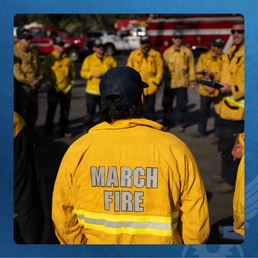
In January 2025, a catastrophic wildfire erupted in California’s Eaton Canyon, burning more than 14,000 acres, destroying over 9,400 structures, and displacing over 100,000 residents. Driven by hurricane-force winds and months of drought, the fire overwhelmed local resources and created a humanitarian crisis in the foothill communities of Altadena and Pasadena.
Amid the chaos, Air Force civil engineers answered the call—not only as technical specialists, but as a lifeline for the communities in distress. Their mission was clear: augment local firefighting efforts, protect lives and property, and restore critical infrastructure. Engineers deployed as part of a Type I strike team, equipped with five structural fire trucks, each able to pump 1,000 gallons per minute and provide 1,900 feet of firefighting hose. Self-sufficient for 72 hours, the team carried food, water, fuel, and medical supplies—everything needed to sustain operations.
When boots hit the ground, the magnitude was undeniable: the air was thick with smoke, burning wood and dry grass stung their nostrils, and the orange glow of fire painted the sky behind the Rose Bowl stadium. Conditions were bone dry—the perfect storm for mass destruction.
For the Airmen at March Air Reserve Base, the deployment reflected something deeper: Air Force civil engineers’ commitment to service, strength, and compassion when disaster strikes. One Airman reflected that seeing families displaced and livelihoods destroyed only reinforced why they train relentlessly.
“There’s an unspoken understanding that we’re all in this together, and we’ll get through it together. Empathy is a huge factor. You see the news footage. You hear the reports. You try to imagine what it must be like to face the threat of losing everything you own, everything you’ve worked for. Families being displaced, livelihoods threatened…that hits you hard. You can’t help but feel a deep sense of empathy for the people of Altadena,” said Michael A. Goodman, Assistant Chief of Health and Safety for March Field Fire Emergency Services.
Civil engineer firefighters integrated seamlessly into strike teams under local command, working side-by-side with municipal crews to defend homes in immediate danger, target spot fires, and conduct overhaul to prevent re-ignition. When water supply issues and equipment failures threatened operations, civil engineer teams improvised—locating alternative sources, troubleshooting pumps, and maintaining continuity under pressure. Their ability to adapt in real time was critical to holding the line.
Goodman recalled a moment of calm after the flames subsided: “The sun was setting over the scorched landscape, smoke rising in whisps from what was left of the community, and there was a quiet that enveloped us. No sounds of cars, no sirens, no roaring fire, just silence. A calm not everyone could understand was in the air."
Thinking back on the mission, Goodman added: “You don’t go into a situation like Eaton alone. You go with your team, and you go for the people who need you most. That’s the calling.”
Eaton proved that expertise, combined with compassion, can drastically change the outcome of a disaster. The Eaton wildfire was a test of endurance, adaptability, and humanity. For the people of Altadena, they restored safety and stability. And for the Airmen who answered the call, Eaton was a reminder of why they train, why they serve, and why they stand ready when communities face their darkest hours.