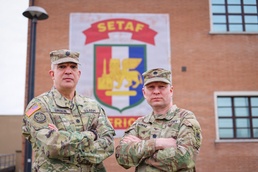
VICENZA, Italy — U.S. Army Southern European Task Force, Africa (SETAF-AF) launched its Advanced Capabilities Directorate, signaling a strategic leap in integrating innovation, data and rapid procurement to enhance modern warfighting, Jan. 5, 2026.
Replacing the former initiatives, the new directorate reports directly to the SETAF-AF chief of staff. It centralizes innovation and operational data efforts to improve decision-making and drive transformation across SETAF-AF missions.
“This is the big news, we’re growing,” said U.S. Army Lt. Col. Nicholas R. Dubaz, innovation branch chief for SETAF-AF. “The Advanced Capabilities Directorate (ACD) brings together our innovation division and operational data team to achieve decision dominance and better use the data we work with every day to execute our mission.”
ACD integrates new technologies, tests how well they work in real situations and shares those results with Army leaders, industry partners and those developing official procedures and guidelines.
“It includes a full-time innovation division who focus on identifying and implementing new technologies, and an operational data team responsible for analyzing and managing information,” said Dubaz.
U.S. Army Lt. Col. Armand L. Balboni fills the newly created science and technology advisor role and serves as the innovation branch deputy chief.
“I’m serving two functions,” Balboni said. “One is helping run the new directorate. The other is ensuring that medical innovation is fully integrated. Innovation isn’t just about acquiring technology. It’s about the human-technology interface, command and control, and how systems function across complex operations.”
Balboni brings extensive acquisition and technology experience.
“I spent 14 years on active duty evaluating and procuring new technologies, along with private-sector experience as a technology company chief executive officer,” said Balboni. “I’m currently a reservist serving on active-duty operational support orders, as well as a professor at the U.S. Air Force Academy.”
The directorate includes officers and specialists focused on operational integration, coordinating internal processes across functions, external outreach and engagement, as well as acquisition.
“One key addition is a full-time Global Tactical Acquisition Directorate (GTAD) representative who serves as a liaison to the Assistant Secretary of the Army for Acquisition, Logistics, and Technology,” said Dubaz. “This representative enables SETAF-AF to pursue faster, more adaptive procurement pathways.”
The ACD will lead innovation support for exercise African Lion 2026 (AL 26).
“Our focus right now is execution,” Dubaz said. “African Lion is where innovation meets reality. We can integrate advanced technology into an exercise, but if we don’t assess it, collect data and understand what works and what doesn’t, then we’ve failed our mission.”
AL26, U.S. Africa Command’s largest annual joint exercise, is led by SETAF-AF from April 20 to May 8, 2026. The exercise validates units and systems under realistic battlefield conditions. AL26 involves more than 5,600 civilian and military personnel from over 30 nations, using innovation to drive partner-led regional security.
“These aren’t demos run by vendors,” Dubaz said. “These systems are in the hands of Soldiers, being used the way they would be in combat. That’s the only way to truly assess effectiveness.”
AL26 will incorporate more than 45 technologies across three operational vignettes: defense in depth, deep attack and counterattack.
“Technologies evaluated include unmanned and counter-unmanned aerial systems, loitering munitions, and autonomous ground systems for breaching and obstacle emplacement,” said Dubaz. “Advanced command-and-control architectures that fuse sensors into a common operating picture are also tested.”
The assessments feed directly into Army decision-making on doctrine, procurement and future investment.
“For many industry partners, this is the first time their technology is exposed to real-world operations,” Dubaz said. “Heat, dust, electronic warfare, heavy loads and battlefield chaos each reveal strengths and weaknesses that no lab can replicate.”
ACD uses an iterative innovation approach to repeatedly collect and examine data, evaluate technology performance and quickly update recommendations. This process ensures insights and improvements lead to actual, usable capability enhancements.
“What works in a lab may not work in the desert, under fire, or with soldiers carrying heavy loads in degraded environments,” Dubaz said. “Our role is to provide feedback so industry can make systems that work when it counts.”
At its core, leaders say the ACD exists to close the gap between technological potential and battlefield reality. It aims to do so at the speed required by modern conflict.
“The traditional procurement cycle is long,” Balboni said. “One of the gaps we’re trying to close is speed, getting the right capabilities to Soldiers in time to actually impact the fight.”
By integrating innovation, data analysis, assessment and acquisition, SETAF-AF positions the ACD to deliver faster decisions, smarter investments and more impactful warfighting capabilities across Europe and Africa.