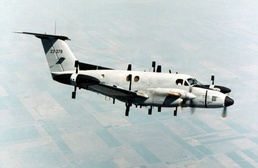
On Jan. 8, 1996, the 138th Military Intelligence Company (Aerial Exploitation [AE]) was ordered to deploy to South Korea in support of the U.S. Eighth Army. The unit would conduct intelligence collection and direction finding (DF) operations using the RC-12G CRAZYHORSE.
The RC-12G CRAZYHORSE was developed in the early 1980s to provide aerial reconnaissance for Army units in Central and South America. The system was designed to locate unique high-frequency emissions in a defined airspace. Unlike other GUARDRAIL systems, intelligence collectors could ride in the back of the aircraft, allowing the system to deploy without the necessity for a ground control system, though it could be remotely operated via satellite with the use of the ground system. Between 1985–1993, CRAZYHORSE was employed for counterdrug operations for U.S. Atlantic and U.S. Southern Command elements.
In 1994, the CRAZYHORSE mission transferred from the U.S. Army Intelligence and Security Command’s (INSCOM) B Company, MI Battalion (Low Intensity) to the Army Reserve’s 138th MI Company (AE). According to Col. Richard Dunbar, the intelligence deputy director for reserve affairs at INSCOM, this was “a giant leap forward for the reserve components. ”With the retirement of the unit’s old system, CEFIRM LEADER, the 138th became responsible for the Army’s only echelon-above-corps, fixed-wing airborne DF system. Training on the CRAZYHORSE system took place throughout 1994 and was significantly condensed due to the limited availability of reservists. Platoon leader Capt. Greg Dalferes noted the 138th “had to react on short notice and do extra training over and above the normal two weeks a year. We progressed faster than anybody expected us to.”
On Jan. 8, 1996, the 138th MI Company, headquartered in Orlando, Florida, was ordered to deploy three mission aircraft, a ground intercept facility (GIF), supporting equipment, and personnel to the Republic of Korea (ROK) to perform intelligence collection and DF operations. This deployment was possibly an avenue to test a replacement for the OV-1 Mohawk, which would be retired from service along the demilitarized zone (DMZ) later that year. A four-person advance party departed for Camp Humphreys, ROK, on Jan. 11, followed three days later by the main body consisting of twenty-eight personnel and support equipment. The three RC-12G aircraft departed on Jan. 15, but were delayed by bad weather and maintenance problems. The last aircraft did not arrive in country until Feb. 7.
Upon arrival, the 3d MI Battalion requested that all the 138th’s missions be flown remotely. This would allow the battalion’s analysts and Korean linguists to work alongside CRAZYHORSE operators on the ground during missions, as the 138th did not have any Korean linguists of its own and was unfamiliar with the targets and target environment along the DMZ. Unfortunately, the 138th MI Company was not trained in using the CRAZYHORSE system remotely.
What commenced was described by the unit’s after action report as “a steep learning curve for all involved.” Initial operations produced little intelligence. While operators found using the GIF identical to working onboard the RC-12G, 138th leadership were “totally unfamiliar with the peculiarities associated with the unmanned mode.” Likewise, other intelligence collection elements operating in the area reported low activity in the target environments during the first four weeks of operations, making it more difficult for 138th operators to identify equipment or operator errors. As the 138th’s personnel gained more experience and target activity increased, so did intelligence production.
The company completed thirty-three aerial exploitation missions by the end of its deployment on Apr. 15, 1996. The deployment was an invaluable exercise for CRAZYHORSE operators of remotely operated missions. It also provided unprecedented capabilities testing of equipment in an environment unlike previous low intensity counterdrug missions and proved the 138th MI Company’s ability to respond rapidly for contingency operations.
Article by Erin E. Thompson, USAICoE Staff Historian. New issues of This Week in MI History are published each week. To report story errors, ask questions, request previous articles, or be added to our distribution list, please contact: TR-ICoE-Command-Historian@army.mil.