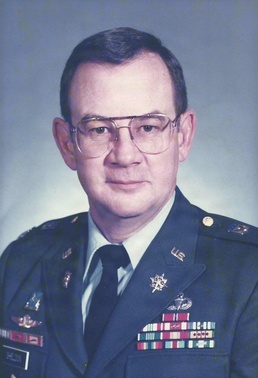
IN MEMORIAM Colonel Douglas Sheldon (Jan. 16, 1943 – Oct. 8, 2025)
Born in Des Moines, Iowa, Douglas Sheldon was commissioned as a second lieutenant of Military Intelligence from the University of Iowa in 1966. During his first assignment, he advised an Army of the Republic of Vietnam (ARVN) collection unit on the development and reporting of critical intelligence on enemy operations in the Central Highlands. Three years later, he returned to Vietnam for a second tour working with the same unit. Sheldon convinced the team to broaden collection operations into the tribal lands of the Central Highlands, tripling its reporting on key enemy operations.
Returning from Vietnam in 1972, Sheldon was assigned as S-2 for 3d Brigade, 82d Airborne Division, where he developed the Brigade’s first tactics, techniques, and procedures (TTPs) for tactical intelligence collection operations and for the division’s first unattended ground sensors. In 1976, Colonel Sheldon became an operations staff officer at U.S. Forces Command, where he developed the intelligence force structure for the U.S.-based force to deploy in support of general war in Europe. The following year, calling on his Vietnam experience and knowledge of intelligence support to light and airborne forces, he became the intelligence trusted agent for the formulation and assessment of a special mission unit that became known as Special Forces Operational Detachment-Delta, or Delta Force.
Sheldon was then handpicked to be one of the original members of the newly developed Joint Special Operations Command (JSOC) in January 1981.As the deputy J-2 for operations, Sheldon started with a staff of five officers and two noncommissioned officers. Over the next three years, he grew his staff to twenty-four members and established the foundations of Army intelligence operations in the joint community.
From January 1984–January 1985, Sheldon served as the G-2 of the 82d Airborne Division. He improved the intelligence communications capabilities within the division and also with higher headquarters and external units. He incorporated special operations forces’ TTPs into the G-2, enhancing his section’s ability to execute the division’s Global Response Force mission. Sheldon then commanded the division’s 313th MI Battalion. During his two-year tenure, he helped reorganize the battalion’s force structure into company teams to better support the division’s high operational tempo, a concept that remained relevant even during the Global War on Terror two decades later.
In 1987, Lt. Gen. Sidney T. Weinstein, the Army’s deputy chief of staff, intelligence, handpicked Sheldon to help develop an intelligence structure for the emerging U.S. Special Operations Command (USSOCOM). Sheldon then served as the Southern Command deputy J-2 during the early days of the “War on Drugs” in South America. He developed and implemented the Tactical Analysis Teams (TATs), which were intelligence cells from the J-2 staff, augmented with personnel from the Defense Intelligence Agency, working within the embassies of select South American countries. The TATs provided host nation forces with national-level intelligence for use in their drug interdiction operations. Colonel Sheldon then spent two years as commander of the Army’s Office of Military Support.
For the final three years of his military career, Colonel Sheldon served first as the J-2 and then as a special assistant to the commander of USSOCOM. After retiring in 1996, he stayed another fifteen years as a civilian in USSOCOM, directing the command’s Joint Intelligence Center. During this period, he helped grow the command’s intelligence structure in both billets and funding, significantly increasing the capability of special operation forces to execute dangerous missions in the most austere environments. He retired from his civilian position as the USSOCOM deputy J-2 in 2011.