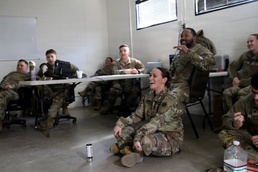
FORT HOOD, Texas - Sometimes life throws you a curve ball. Life threw one at a National Guard unit from Oklahoma, and they are doing their best to remain positive during an uncertain time.
“I try to tell people to reframe this as an opportunity,” 1st Lt. Julia Rusert said. “It’s an opportunity to see what you are made of and it’s an opportunity to grow, because you are not tested when things go the way they are supposed to go. The only time that you know what you are made of and have the opportunity for growth is when you have to go through something hard.”
Rusert, the executive officer of the 120th Medical Company - Area Support, 120th Engineer Battalion, Oklahoma Army National Guard, has a front row seat to the hardship and growth some members of her company are experiencing.
When their National Guard unit got the call to mobilize, they did all the right things. They increased their medical training and tested their standard operating procedures, completed their weapons qualifications, took their physical fitness tests, shipped their medical equipment overseas, packed their bags and left Oklahoma to mobilize through Fort Hood.
They uprooted from their homes, gave notice to their civilian jobs, said goodbye to their loved ones and showed up to fulfill the obligation that they raised their right hand and swore an oath to abide by.
Prior to arriving at Fort Hood, Soldiers with the 120th MCAS trained for three weeks and completed pre-medical training where they set up their medical care station and simulated a mass casualty event with evacuations to test their capabilities. Once they arrived here, the unit went through a series of administration and medical checks to be sure they were fit for deployment.
“We got here on a Sunday and went through the Deployment Readiness Center on Monday and Tuesday and then found out on Friday that our mission was cancelled, just after we were cleared to go,” 1st Sgt. Heather Riggins, 120th MCAS’ senior enlisted leader, said.
Quite simply, they had a mission to serve in an aid station in the Middle East, providing medical support as part of Operation Inherent Resolve, and that was cancelled. Now the Soldiers of the 120th are in a holding pattern and are awaiting new orders and a new mission. For some, the wait and the unknown destination of their new mission is difficult.
“The hardest thing for everyone has been being in limbo," Rusert said. "They are just sitting and waiting, which can be a very good exercise because one of the harder parts of being in the Army is holding position.”
Soldiers with the 120th have tried their best to remain positive and patient as they await news of where and when they will be sent for a new mission. Possibilities include individual missions and not deploying as an intact unit. For many of them, this is a test of mental fortitude.
“I’ve never experienced a situation like this before. I plan everything in my life. I am learning so much, like patience and being able to accept what I can’t control, which is huge,” said Capt. Christina Greff, a medical surgical nurse with the 120th MCAS who has served for 15 years. “To stay positive, I’ve been journaling and walking a lot and trying to get as much sunshine as possible and remembering that it’s all temporary."
Others have found solace in their camaraderie and have increased the activities they do together. Some activities include going to the gym, playing competitive games, celebrating December birthdays, instructing each other on classes and “hip pocket" training.
“We have to be flexible and remember that we are Soldiers first and are here to perform a service," Greff said. "We are here to sacrifice and sometimes that means sacrificing our time and sometimes that means sacrificing control of not knowing what is going to happen next.”
Each of the Soldiers of the 120th MCAS have had to rely on their mental agility to help them navigate this unusual scenario.
“It’s a tough situation, but it’s been an incredible learning opportunity, and a lot of beauty has come out of this,” Rusert said. “In the Army, you are always going to have stuff not go the way that it’s supposed to and that gives you the ability to think through problems and overcome adversity.”
One problem they are working to solve involves the unit’s specialized medical equipment that has already been shipped to the Middle East. The logistics will be challenging, to move their equipment to where it is needed once their new mission is realized.
“If I didn’t have my battle buddies, it would be a lot easier to be frustrated,” Riggins said of the enormous strain the situation has put on the leadership. “Honestly, I’m a Christ-believer and my faith has really helped me as well, knowing that this is His path.”
The unit has exercised their mental fitness by participating in resiliency classes in the past and currently has a psychologist assigned to them that has led group discussions so the Soldiers in limbo can talk to each other about what they are experiencing.
“I know that we’re all in this together and as they say, ‘embrace the suck,’" Riggins said. "We laugh at different things now because we’re just in a waiting pattern and we expect to get a mission soon.
"Hopefully we’ll know next week. That’s my answer to everything. Maybe next week.”