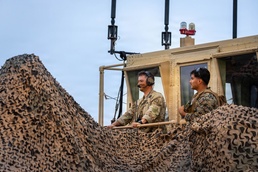
FORD ISLAND, Hawaii - Soldiers from Foxtrot Company “Paniolos”, 3rd Battalion, 25th Aviation Regiment, 25th Combat Aviation Brigade (CAB), augmented with U.S. Marines from Mike Company, Marine Air Control Squadron 4, Marine Air Control Group 18, to perform airfield operations at Ford Island, Oahu in support of Task Force Saber during Joint Pacific Multinational Readiness Center (JPMRC) rotation 26-01.
During the exercise, Foxtrot Company provided expeditionary air traffic control services during the Long-Range Maritime Air Assault (LRMAA), enabling the safe launch, recovery, and sequencing of aircraft operating at Ford Island throughout the rotation.
From Nov. 3–17, 2025, Soldiers from the 25th CAB participated in JPMRC 26-01, a 15-day training exercise conducted across the Hawaiian island chain. The exercise served to certify 2nd Squadron, 6th Cavalry Regiment “Task Force Saber”, 25th CAB, and 3rd Mobile Brigade, 25th Infantry Division (ID). The LRMAA is a key event that tested the Army’s ability to project combat power across maritime environments, with Task Force Saber transporting 3rd Mobile Brigade forces more than 200 miles over open water.
“This took months of coordination prior to our deployment,” said Capt. Anne Allen, commander of Foxtrot Company. “My platoon leaders played a major role, working with Task Force Saber safety officers, 25th CAB and 25th ID staff, Ford Island leadership, and Honolulu International Airport authorities to ensure airspace and land were properly coordinated.”
During the exercise, Foxtrot Company controlled airspace from ground level up to 400 feet to safely integrate military aircraft operations alongside Daniel K. Inouye International Airport (HNL Airport) civilian airspace. Alongside airspace management, the company controlled an airfield stretching more than a mile long, with an estimated 340 personnel operating on ground.
At peak activity, more than 30 aircraft were staged across Ford Island while petroleum supply specialists operated Heavy Expanded Mobility Tactical Trucks (HEMTT) and aviation maintenance crews conducted repairs along active flight lines. Air traffic controllers from Foxtrot Company synchronized aircraft movement on the ground and in the air to ensure safe and continuous operations.
Foxtrot Company sequenced aircraft using its Mobile Tower System, a rapidly deployable air traffic control tower designed to support sustained operations in locations without permanent aviation infrastructure. Once established, the system enables air traffic controllers to provide full control tower services shortly after arrival. A critical capability for the 25th ID, a light infantry division that routinely operates in expeditionary environments.
“The Mobile Tower System is the most visible thing on the airfield,” said 1st Sgt. Carlos Hernandez, Foxtrot Company’s first sergeant. “Pilots see it and know they’re operating in controlled airspace. The facility is staffed by seven personnel – a facility chief, two shift leaders, and four controllers – all of whom are essential to maintaining 24-hour operations.”
The system is equipped with multiple radio capabilities, including high frequency, satellite communications, ultra-high frequency, and very high frequency radios. These systems allow air traffic controllers to communicate with both military and civilian aircraft using secure and unsecure channels as required.
Throughout the operation, Soldiers and Marines worked jointly inside the Mobile Tower System to support continuous aviation operations. Marines embedded with Foxtrot Company provided certified weather surveying equipment, enabling accurate wind and altimeter readings to be transmitted to pilots, further increasing flight safety.
“Working with the Marines has been a great experience,” said Sgt. Joshua Jenkins, an air traffic control operator assigned to Foxtrot Company. “They bring a lot of knowledge and help strengthen how we train and operate as a team.”
Behind the scenes, Air Traffic Control System Maintainers, also known as 94Ds, ensured the reliability of Foxtrot Company’s equipment. These Soldiers are trained to maintain and troubleshoot the company’s primary air traffic control systems, including the Mobile tower System, Tactical Terminal Control System, Tactical Airspace Integration System, Air Traffic Navigation, Integration, and Coordination System. Their work ensured uninterrupted support throughout the exercise.
During JPMRC 26-01, Foxtrot Company enabled Task Force Saber to operate from Ford Island by providing a safe, controlled airfield environment. Air traffic controllers coordinated the movement of 25 helicopters in support of the air assault of 3rd Mobile Brigade forces onto the Island of Hawai’i. Following completion of the mission, Foxtrot Company continued to control airspace at Ford Island until Task Force Saber redeployed to a follow-on location.
“I’m proud of our Paniolos team,” Allen said. “Despite added stressors and changes throughout the exercise, our Soldiers remained resilient, adaptable, and professional, ensuring we consistently delivered safe and reliable air traffic control services in support of the mission.”
As JPMRC 26-01 concluded, Foxtrot Company continues to train and refine its expeditionary air traffic control capabilities, remaining prepared to support Army Aviation and joint forces across the Pacific wherever future operations are required.