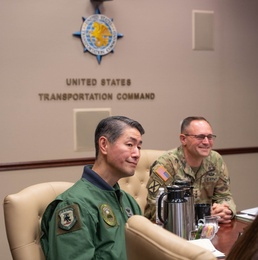
Japan’s top air mobility officer met with U.S. Transportation Command leaders this week to tighten defense coordination across the Indo-Pacific.
Lt. Gen. Chuji Ando, who oversees the Japan Air Self-Defense Force’s Air Support Command, traveled to Scott Air Force Base, Illinois, for a two-day visit focused on airlift and aerial refueling. The trip follows USTRANSCOM Commander Air Force Gen. Randall Reed’s June 2025 engagements in Tokyo and at Yokota Air Base, where he emphasized the importance of integrated mobility and alliance sustainment.
Army Lt. Gen. Jered Helwig, USTRANSCOM’s deputy commander, said the discussions here “will have a lasting impact on how we project and sustain a combat credible joint force in contested environments,” adding that global mobility relies heavily on steady, operationally aligned partnerships.
One of the key topics on the agenda was the Civil Reserve Air Fleet, the U.S. program that contracts with commercial airlines to provide surge airlift during national emergencies. While CRAF is a domestic framework supporting the U.S. military, allies study how the United States integrates civil and military capacity to meet rapid, large-scale mobility demands.
“In modern warfare, that logistical demands have been growing dramatically, it is no exaggeration to say that the success of operations depends on the success of transportation and aerial refueling,” Ando said. “While we have no Reserve, National Guard, or CRAF fleet in Japan, I have recognized CRAF as a highly practical framework we should pursue in the future to expand our capacity in response to increased demands. Gaining deeper insight into USTRANSCOM’s initiatives and engaging in candid discussions with senior leaders was an invaluable opportunity.”
More than 20 carriers and over 800 aircraft currently participate in CRAF, making it one of the Department of War’s most significant surge capabilities.
“CRAF is a unique and significant part of our nation's air mobility capacity and is critical to Department of War operations,” Helwig said. “This additional capacity supports planned, deliberate fleet management across the total force to ensure joint force lethality 24/7.”
During his visit, Ando also met with Air Mobility Command leaders. AMC — the air component to USTRANSCOM — provides global airlift, air refueling and aeromedical evacuation and plays a central role in projecting the joint force.
For the leaders at AMC, the opportunity to host their Japanese counterparts was more than a routine engagement; it was a powerful reaffirmation of a significant partnership. Air Force Gen. John Lamontagne, AMC commander, reflected on the visit's significance, connecting the day-to-day cooperation with the overarching strategic imperatives in the Indo-Pacific.
“Our alliance with the Japan Air Self-Defense Force is a vital component of stability in the Indo-Pacific,” said Lamontagne. “It was an honor to host our Japanese partners and provide them a firsthand look at how our Mobility Airmen deliver Rapid Global Mobility for the joint force. These engagements strengthen our interoperability and reinforce our shared, unwavering commitment to collective defense and deterrence. We are always stronger when we fly and train together with our allies.”
___
Capt Denise Guiao-Corpuz, Air Mobility Command public affairs, contributed to this article.