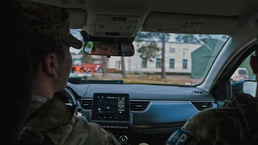
ĀDAŽI, Latvia — Military Police serve a unique and essential role within the U.S. Army. While they wear the same uniform as every service member, they also carry the unique responsibility and authority of upholding law and order as law enforcement professionals. Military Police Soldiers are charged with maintaining good order and discipline. They operate in situations where duty takes precedence especially when responding to incidents, securing installations, or enforcing regulations. Across the force, Military Police fulfill a wide range of missions, including protecting senior leaders, conducting gate and traffic operations, supporting criminal investigations, and patrolling in both garrison and combat environments. In a multinational setting like Latvia, their responsibilities also include coordination and cooperation with allied forces to reinforce unity and readiness across NATO’s eastern flank. While deployed in support of Operation Atlantic Resolve U.S. Army Spc. Mark Garcia, a Military Police Soldier assigned to the 327th Military Police Battalion, 102nd Military Police Company, claimed the diversity of the mission(s) is what makes the career field meaningful for him. One of his most impactful experiences came during the 2025 Best Squad Competition for the 200th Military Police Command, where Soldiers were tested physically, mentally, and tactically. “It was a great experience in the events that were given.” —- “My most memorable moment as an MP was having the opportunity to compete in the Best Squad Competition,” Garcia said. “The ruck marches, German Armed Forces Proficiency Badge events, Expert Soldier Badge tasks, and the final simulated rescue operation really challenged us and brought all of our training together,” he said. The Army Best Squad Competition tests squads’ technical and tactical proficiency and their ability to function as cohesive teams under stress. Open to Soldiers of all ranks and specialties, the competition highlights those who exceed the standard and reinforces Army values and teamwork. He emphasizes professionalism, accountability, and setting the example—qualities vital to Military Police. “Our role here is really to be an example,” Garcia said. “As Military Police, we have to be the standard in our actions, but it’s also about outreach—building community and helping wherever we’re needed,” he said. During a ride-along with two 327th Military Police Battalion Soldiers, Spc. Garcia and Pfc. Jack Hajewski, I was afforded a glimpse into the kinds of tasks and duties they perform while deployed. The two MPs did outline patrols, and Random Antiterrorism Measures at the Canadian-led base in Ādaži. While often perceived as routine, these operations are a key component of force protection, providing a visible security presence and enhancing situational awareness across the installation. “The importance of conducting a RAM is to spot activity that may go unnoticed during regular patrols,” Garcia said. “By conducting them randomly, it adds an element of surprise and strengthens overall security.” Garcia emphasized that enforcement is not always about authority or force, but often about communication and accountability. “When you respond to calls, sometimes people get themselves into trouble,” Garcia said. “Nobody is perfect. But being able to talk to someone, bring some light to the situation, and help them understand they can do better—that’s a big part of why we do this.” Currently mobilized from the U.S. Army Reserve, Garcia said one of the most rewarding aspects of the deployment has been working alongside NATO partners, including Latvian, Canadian, and Slovenian forces. Stationed at a Canadian-overseen base, Military Police regularly train and operate alongside their Canadian counterparts. “They’re very respectful, very knowledgeable, and willing to share what they know,” Garcia said. “Working with Canadians really showed me that this isn’t about just one nation. We’re all in the same boat together.” These partnerships enhance interoperability and mutual understanding among allied forces through joint patrols, shared training, and daily interaction. For Military Police, these relationships strengthen readiness while reinforcing NATO’s collective commitment to deterrence and regional stability. Deployments like Operation Atlantic Resolve provide service members with the opportunity to grow professionally by taking on leadership roles, sharpens physical readiness through rigorous training, and refines tactical proficiency by participating in real-world missions. For Military Police, operating alongside allied forces reinforces adaptability and highlights the importance of unity in multinational environments. For those considering military service or a career as a Military Police officer, Garcia offered simple advice. “Don’t be discouraged,” Garcia said. “Be open-minded and mentally prepared. A lot of what you learn comes from the experience itself, and being adaptable is what really makes the difference. Serving as a Military Police Soldier is about resilience, growth, and contributing to something larger than yourself—qualities that endure long after the mission is over.”