By Lt. Isabel Shaw
Information Warfare Training Command Virginia Beach
VIRGINIA BEACH, Va. – Petty Officer 1st Class Eric Anderson knew his students needed a clearer, more tangible way to grasp just how many variables emerge when assessing a target’s physical environment.
The intelligence specialist and Information Warfare Training Command Virginia Beach instructor started by building a simple cardboard model, but it lacked the depth, complexity and precision he needed to emulate operational intelligence concepts to students.
“It was really bad, but it led me to another idea,” he said. “Why not use Legos? Everybody understands Legos.”
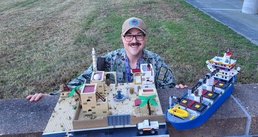
For two weeks, Anderson meticulously built a mock insurgent compound, brick by brick. What began as a single structure designed to support a few learning objectives soon evolved into a sprawling vignette that mirrors the complexity of an urban warfare environment.
The model’s success quickly sparked interest across enlisted and officer intelligence courses at IWTC Virginia Beach, prompting a growing demand for his Lego-built training tools. In just the past two weeks, he has engineered a second model of a detailed merchant shipping vessel, now slated for use in the Basic Shipboard Intelligence Course and Maritime Security Intelligence Operations Course.
The Lego model is riddled with operational dilemmas and opportunities for intelligence analysts to sharpen their battlespace awareness. Overgrown weeds on the ground encircle a dry well, hinting at low activity or poor upkeep.
Throughout the scene, visual cues prompt students to weigh humanitarian considerations and the laws of armed conflict that shape strike operations. The principle of distinction, for example, is reflected in a protected religious site’s inclusion.
Weaponeering questions are also embedded within the model’s design. The compound buildings and walls are constructed of distinct materials such as reinforced steel, exposed brick and composite pieces – each presenting its own challenges and opportunities. Three structures share a single power line, prompting students to identify a small gas generator as a potential center of gravity. Within this scenario, they’re tasked with identifying kinetic effects that are both proportionate and effective.
Outside the compound walls, Anderson installed myriad traces of adversary capabilities and intentions, beckoning the viewer to closely examine and scrutinize details. Students can peer inside the battered shell of a small building and note destroyed utilities and the remains of a roof, indicating limited feasibility for long-term use.
A pockmarked roadway raises several important questions about maneuverability and the potential presence of improvised explosive devices. Farther up the road, a pickup truck fitted with a gun mount offers yet another clue for students to dissect.
Anderson’s creative process didn’t just produce a training tool; it sparked new ways to enhance learning across courses. The Lego compound is now used in IWTC Virginia Beach’s K-10A Imagery Course to help illustrate complex techniques that students often struggle to visualize.
“The computer systems don’t always demonstrate concepts in a way students understand, so the Lego model helps bridge that gap,” Anderson explains.
None of Anderson’s complex designs come from kits or instructions; each one is built entirely from scratch. He selects every individual brick with a clear vision and rare talent for translating operational realities into a medium that resonates with students at multiple levels.
Instructors say his models reflect an uncommon degree of creativity and innovation, one IWTC Virginia Beach is proud to foster.
“When everything revolves around simulation and modeling, IS1 Anderson’s work delivers a classic, back-to-basics visual approach,” said Chief Warrant Officer 4 Karl Barnes, who utilizes the models for his courses. “He is also demonstrating how Sailor ingenuity will always be the standard by which all others are measured. It’s refreshing to see a Sailor valuing innovation and initiative while training information warfare teams for a future strategic competitor fight.”
IWTC Virginia Beach, part of the Center for Information Warfare Training, offers more than 70 specialized courses in fields such as information technology, cryptology and intelligence. The command is staffed by about 330 military, civilian, and contractor personnel and trains over 6,500 students a year at locations across the U.S., including Jacksonville and Mayport, Florida; Naval Submarine Base Kings Bay, Georgia; and Groton, Connecticut.
CIWT’s network of four schoolhouse commands and multiple training sites around the globe delivers world-class instruction to more than 26,000 students annually. It ensures the Navy, Marine Corps and Department of War are equipped with the highest caliber of intelligence professionals, ready to meet the demands of a rapidly evolving global landscape.