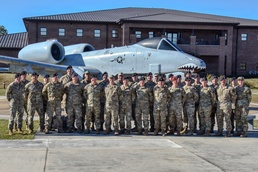
MOODY AIR FORCE BASE, GA. -- Leaders from the 93d Air Ground Operations Wing, the 3d Air Support Operations Group and the 18th Air Support Operations Group convened from Dec. 9-10, 2025, to attend the Semi-Annual Tactical Air Control Party Spartan Senate at Moody Air Force Base, Georgia.
The Spartan Senate centered on Air Force Special Warfare Evaluation Standardization, Air Force Force Generation Cycle (AFFORGEN) deployment schedules and new Human Performance Optimization (HPO) training implementation in an effort to prepare for the pacing challenge and evolving global threats.
"It’s all about sharpening the spear,” said Col. David M. Anderson, 18th ASOG commander. “TACP leadership gathered this week to align on the future of precision strike and command and control at the tactical edge. Our mission remains clear: evolve the force to remain the decisive link between air power and ground maneuver and serve as key enablers of the long-range kill chain.”
The goal was to ensure all TACP leaders share a unified vision for building a capable and modernized TACP force. This standardization is particularly critical as the mission evolves and the Air Force integrates new technologies and faces a dynamic threat landscape.
“That's our job, to train and equip these squadron commanders with what they need to ensure 24/7 readiness of their TACPs, so they can confidently get after the mission anywhere at any time,” said Col. John Blocher, 93 AGOW Commander. “It is imperative to ensure we are evolving together, in the same direction and to same standards along the way.”
Modernization efforts are driven by the evolving threat environment, particularly the pacing challenge presented by strategic competitors. For the 3 ASOG and 18 ASOG, these efforts include incorporating small unmanned aerial systems and advanced communication systems to maintain secure connectivity in contested environments.
The other side to modernizing communications is via C3 or command, control, communication in a distributed fashion to achieve distributed control. C3 is accomplished through advanced waveforms and radios to maintain secure communications both on radio waveforms and IP-based or computer-based internet pathways to ensure TACPs remain connected in contested environments, where jamming is most prevalent as they forward deploy and can become more easily identified and targeted by adversaries.
“The reason we modernize is because the threat is changing,” said Capt. Jeremy Mootz, 93 AGOW A33 Current Operations Division Chief. “Always begin with the target. It's the thing you want to kill and the thing that's trying to stop you from killing it. Then work backwards from there.”
Identifying the right-size unit type codes, or deployment capabilities, to successfully align with the AFFORGEN cycle as well as the Army’s deployment cycles also became a key topic of discussion in an effort to address TACP manning constraints and ensure survivability in conflict.
AFFORGEN is a 24-month cycle of training composed of four phases – Reset, Prepare, Certify and Available, which begins at the individual level and then builds to small team training and eventually into larger teams working together along with sister services or other Air Force capabilities depending on the deployment tasking. These Air Force or joint teams must then undergo a certification process, proving their readiness and lethality to the supported combatant commander downrange.
“What we are trying to move away from is called crowdsourcing the fight or deploying our Airmen as individuals to fulfill isolated deployment requests to various locations world-wide,” said Chief Master Sgt. Stephen Dugan, 93 AGOW Command Chief. “We must train to fight as a team with the goal to then certify the team as a combat ready unit after successfully completing a capstone exercise during the Ready phase of the AFFORGEN cycle. This approach has proven to not only take care of the mission but most importantly our TACPs.”
Key to aligning a unit’s readiness is dictating and standardizing training standards that get accomplished throughout each AFFORGEN phase.
“We must all show up trained and prepared to the same standard regardless of where we are being sent,” said Col. Ulysses Linares, 3 ASOG Commander. “This way, when a TACP Airman shows up, commanders know they are getting the same person regardless of which area of responsibility they are supporting. We’ve got to be ready to go on day one.”
However, because readiness begins at the individual level, which then translates into the lethality of the unit as a whole. the 93 AGOW Human Performance Optimization Team is working to implement some of the same human performance principles, which normally get accomplished in-garrison, at the beginning of the AFFORGEN cycle and translate them to the back half of the cycle to include the Certify and Available phases.
“The HPO team is working to integrate our practices into what the Airmen are already doing for operational training,” said Lt. Col. Ronald Miller, 93d AGOW director of Human Performance. “Our hope is to introduce human performance factors that converge with operational requirements. We can’t deploy with them and provide our day-to-day services in real-time, so we’re asking ourselves, ‘how can we train our teams in a meaningful way, before they step out the door?’ The best way to accomplish this is to leverage the overarching principles of Comprehensive Airman Fitness, standards of physical, social, cognitive and spiritual domains of health and performance to train within exercises and certification events throughout the AFFORGEN cycle.”
Such training is anticipated to include trauma combat casualty care (TCCC) with live patient models, while performing operational tasks such as live-fire maneuvers or calling in medical evacuation requests. Still the transition to a new level of training and readiness will not be accomplished without expected points of friction. Anticipated friction points include breaking old habits and shifting to prioritizing team-based readiness as much as individual training.
“Fundamentally, a transition from the individual to a team mentality will need to take place,” said Dugan. “I am not focused on training up individuals and stopping there. I am focused on training up teams that are qualified and certified and challenged in training, so I know on day one, when they get off the plane downrange, as a team, there’s a combat capable team that is as survivable and lethal as I could possibly make them.”
“The bottom line is the Department of War needs TACPs ready to fight today,” said Blocher. “If called upon, we stand together ready conquer.”