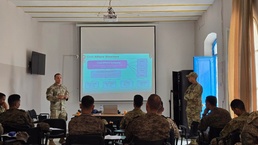
BIZERTE, Tunisia — U.S. Soldiers provided Tunisian Armed Forces and Brigade des Forces Spéciales with training in civil affairs operations at Camp Ramadia, Tunisia, Oct. 6-24, strengthening civil-military capacity.
Instructors assigned to Civil Affairs Team Tunisia, Bravo Company, Civil Affairs Battalion, U.S. Army Southern European Task Force, Africa (SETAF-AF) started by giving TAF and BFS students a basic understanding of key civil affairs tasks, like civil engagements and civil reconnaissance. The course progressed to more advanced topics, emphasizing the role of CAO in countering violent extremist organizations. Practical application exercises in field-training environments later reinforced classroom instruction.
This most recent training session followed previous instruction CA teams have given to TAF and BFS personnel. Since June 2025, CA Team Tunisia has graduated 37 students from various Tunisian units, and these tactical-level courses have extended from two to three weeks.
According to U.S. Army Maj. Bradley Swartzlander, SETAF-AF’s civil affairs team chief in Tunisia, his team’s mission centers around strengthening the U.S.-Tunisian relationship and enhancing Tunisia's ability to manage civil-military operations for improved burden sharing. Swartzlander’s Soldiers achieve this by teaching courses that develop and enhance civil-military operations capacity across various TAF branches and units.
“This training not only helps Tunisia address domestic challenges like violent extremism, illicit trafficking and border security, it also supports their goal of becoming a regional security leader and improves information sharing with civilian populations,” Swartzlander said. “Ultimately, our work contributes to U.S. national security interests by strengthening our relationship with a key partner in North Africa.”
He added that civil affairs teams also support other U.S. training initiatives in Tunisia and assist the U.S. Embassy through joint exercises, such as African Lion, and by enhancing embassy crisis response capabilities.
U.S. Army Staff Sgt. Ryan Karolides, civil affairs team sergeant, emphasized that civil affairs operations are essential to Army readiness because civilians constitute most of today’s operational and information environments. The nature of modern warfare has shifted from traditional battlefield engagements to fast-paced, complex conflicts involving entire societies and new technological advancements. As a result, the Army must address the needs and concerns of local populations.
“CA units are trained to engage with civilians and help mitigate the negative impacts of military operations on their lives and economies,” Karolides said. “This builds trust and fosters civil-military cooperation, which is crucial in counterterrorism and counterinsurgency operations where adversaries often operate among civilians, and success hinges on which side the population supports.”
Karolides said CA's involvement in shaping operations before and after conflicts supports readiness by addressing potential conflict and gathering vital information. It is also crucial for fostering stability and preventing future crises.
In wartime, although civil affairs operations are nonlethal, Swartzlander explained that they act as a significant combat force multiplier and directly enhance the Army's lethality. By fostering stable civil-military relationships and cooperation, civil affairs operations counter violent extremist organizations’ influence, preventing them from gaining local support. In the big picture, CA enables the Army to maximize combat power and accomplish missions without being hampered by civilian complexities.
“CA teams gather information from civilian environments to map and analyze human terrain,” said U.S. Army Sgt. Matthew Rucker, civil affairs noncommissioned officer. “This benefits combat units with more freedom to focus on their primary combat objectives. These key civil factors give commanders an accurate understanding of the battlefield for better decision making when applying lethal force against military targets, while minimizing civilian interference and collateral damage.”
U.S. Army Sgt. Anthony Francis, civil affairs noncommissioned officer, noted that TAF leadership recognizes the value in their soldiers receiving CA training to address today’s security challenges. He went on to clarify that these challenges often require more nuanced solutions than traditional military responses can provide.
“TAF leaders have seen how these skills help their units operate more effectively, at home and during peacekeeping missions abroad,” Francis said. “The expansion of the course from two to three weeks was driven by their request and reflects their growing appreciation for the advantages civil affairs operations bring to the table.”
Swartzlander added that the continued expansion of the training underscores the strength of the U.S.-Tunisia partnership, reinforced through regular engagements and joint participation in major exercises like African Lion and Flintlock.
“This successful collaboration has fostered lasting professional trust and enhanced our ability to work together on civil-military operations,” Swartzlander said. “The Tunisian Ministry of Defense has requested a fourth phase of the course, focusing on train-the-trainer content. This is a crucial next step to enhance Tunisia’s capabilities as a regional security provider and strengthen U.S.-Tunisia relations.”
The team is further developing this course and preparing to implement it later in 2026.