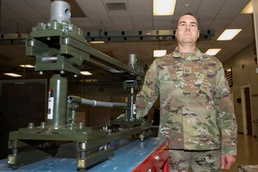
A learning experience quickly turned into a career-defining moment for Senior Master Sgt. Slaughter.
After being announced as a finalist earlier this year, Senior Master Sgt. John Slaughter, 307th Aircraft Maintenance Squadron production superintendent, won the 2025 Department of the Air Force Spark Tank competition following his final pitch of the Pylon Loading Adapter (PLA) at the Pentagon, Dec. 4, 2025.
DAF Spark Tank is an annual competition hosted by the Department of the Air Force that encourages innovative thinking and problem-solving among officers, enlisted members, and civilian employees. Applicants identify an issue affecting efficiency and submit it in a package that includes a proposed solution for the problem.
This year, wanting to understand the application process, Slaughter submitted his PLA, not expecting it to win.
“I knew it was a solid project; however, I did not anticipate it winning the competition. I just figured with the stiff competition out there that it would have been overshadowed,” said Slaughter. “So that was the genesis for getting it into Spark Tank – just to learn how to do a submission on my own so I could help other people.”
His desire to help others ultimately compelled him to create the PLA, leading him to take safety concerns regarding the B-52 Stratofortress pylon loading process seriously when his fellow maintainer SMSgt. John Donelson, 307th Aircraft Maintenance Squadron Production Superintendent brought them up.
“You’re carrying this thing up and down the stand, and it just looked sort of inherently unsafe,” said Donelson. “I was watching this and thinking, ‘We can do better than this.’ That’s when we had the idea of using the jammer, not just for the pod, but for the adapter as well, and contacted John (Slaughter).”
Shortly after discussing potential solutions, Slaughter revealed the PLA in the form of a design and blueprints.
“He's always been the guy to go to for really anything,” said Donelson. “It's like, ‘Hey, I've got this idea!’ and he’ll put his big brain on it – draw it, draft blueprints, work out a design, and take it from there.”
Though Slaughter initially pushed forward with the development of the PLA based on local safety concerns, his research revealed that maintainers across the Air Force were experiencing the same issues.
“Through our research of the presentation, we discovered that the pylon maintenance, removal, and installation result annually in five major mishaps, injuries, and millions of dollars of damage a year,” said Slaughter. “So across the Air Force, this was something that was recognized and one of the factors that made it (PLA) so popular.”
It was this relevance that he believes helped his submission stand out.
“The Air Force is full of people whose daily lives are impacted by aircraft maintenance,” he said. “I think the project benefited from the fact that you could look at the presentation and the pictures and quickly grasp why this was necessary.”
When briefing others on the benefits of the PLA, Slaughter always seemed to receive the same question: Why don't we already have this?
“I think the fact that it's so relatable made it impactful for many people,” he said.
As a finalist, Slaughter was assigned a pitch coaching consultant in Minnesota by the Spark Tank team. Here, he worked with them for a week to create a version of his pitch that would further impress the DAF panel.
Following his consultation, Slaughter returned to Barksdale to continue revising and memorizing his pitch. “It was a nerve-wracking process, and the preparation was actually a month’s long process,” he said. “I’d started doing revision to the presentation, and the one that was submitted was up to the 13th version."
On Dec. 4., Slaughter delivered what he described as the longest three minutes of his life.
“My main goal was to not mess up the presentation,” he said. “Once I delivered the pitch, I felt like a weight had been lifted off of me, and I could finally relax. Whatever the outcome was, I was good with it.”
After all finalists presented, judges announced the top-ranking projects—Power Resilience in Military Environments (PRIME) and the PLA.
Following a brief tie, the final judge cast the deciding vote, naming PLA the winner.
“I couldn’t believe it; I was shocked. It was very exciting,” he said.
Though it is currently being used at Barksdale AFB, Slaughter will continue testing the PLA with a top-tier engineering consulting team assigned to him by Spark Tank.
“It’s an innovation consultant company and their team is amazing,” said Slaughter. “Every one of their members has at least 20 to 30 years of experience in the manufacturing and engineering fields.”
Slaughter is currently collaborating with the team, sharing ideas to strengthen the PLA and enhance its adaptability to various airframes and attachments across the Air Force.
With other projects in the pipeline, Spark Tank has not seen the last of Slaughter. In the meantime, he wants others to feel encouraged and inspired by his story.
“Persistence, above all else, made the difference,” he said. “Many people have good ideas, but without determination they often stall. At numerous points during this development, we could have stopped, but we kept pushing forward."