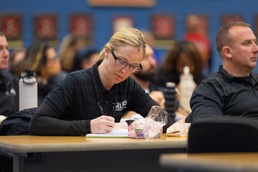
FORT SILL, Okla. — Participants in the Department of War Executive Leadership Development Program visited Fort Sill on Dec. 13, 2025, as part of a temporary duty assignment designed to expose emerging leaders to strategic missions, history and joint perspectives across the force.
The Department of War ELDP is a highly competitive, 10-month enterprise program for high-potential mid-level civilians and military officers. The program targets GS-12 to GS-14 civilians and O-3 to O-4 officers and focuses on developing strategic thinking, adaptability and leadership in complex environments through experiential learning, field deployments and direct engagement with senior leaders and warfighters. The program is administered by the Defense Civilian Personnel Advisory Service.
During their visit, cohort members received an overview of the Joint Counter–Small Unmanned Aircraft Systems University mission from the organization’s director, Lt. Col. (P) John Peterson, highlighting Fort Sill’s role in joint and emerging capabilities across the Army and Department of War.
Participants also heard from Dr. Alvin Peterson, Senior Executive Service Level I and deputy to the commanding general of the Fires Center of Excellence, who spoke about leadership, self-development and readiness.
“Success is when preparation meets opportunity,” Peterson told the group. He emphasized that as a senior leader, he is committed to continuous self-improvement, describing that effort as the preparation necessary to be ready when opportunity arises. He emphasized to the group that "leaders read."
The group toured the Fort Sill National Historic Landmark and Museum, where Fort Sill Director of Museums Dr. Scott Neal provided an in-depth look at the installation’s history and showcased rare Native American artifacts, emphasizing the post’s cultural and historical significance.
Participants also heard from Sara Ratcliff, a retired Senior Executive Service Level III and former chief human capital officer executive director, who discussed executive leadership, public service and the importance of investing in future leaders. Ratcliff created ELDP during her tenure in Washington, D.C. She is also the mother of Virginia Aid, Fort Sill’s community relations director, who helped plan the ELDP visit to the installation.
According to Fort Sill Deputy Garrison Commander Julia Sibilla, an ELDP alumna, Fort Sill provides an ideal environment for developing senior leaders.
“Fort Sill is a terrific example for leaders to see and understand the necessity of continuous transformation and adaptation to the national security concerns and challenges facing our country,” Sibilla said. “Throughout its storied history, Fort Sill has met the nation’s current challenges while adapting to emerging ones. Senior leaders need to do the same — adapt, develop and meet the challenges facing them to remain relevant and effective.”
Sibilla said this year marked the fourth consecutive year Fort Sill has hosted the ELDP cohort.
“They leave here with a sense of the historical importance in our nation’s ethos, but also with a renewed appreciation for the adaptability and sense of service that Fort Sill’s workforce has maintained throughout its 150-year history,” she said.
ELDP participant Jessica Solis said the visit offered a deeply personal and reflective experience.
“My first visit to Fort Sill profoundly exceeded my expectations,” Solis said. “Witnessing the commingling of the Native community and the U.S. Army was a powerful testament to healing — where a painful history has given way to reconciliation, enduring peace bonds and genuine friendship.”
Solis, a Native American Latina and Army veteran, said the experience resonated with her both personally and spiritually.
“Listening to the historical retelling of events on this land and meeting descendants of Quanah Parker — whose leadership shaped peace between the Comanche, Kiowa and the U.S. Army — was both humbling and inspiring,” Solis said. “Visiting the Apache POW Gravesite, as someone of Apache descent and a veteran, was especially meaningful, honoring warriors whose legacy continues to shape our military history.”
Participants also discussed how Fort Sill’s history reinforced key leadership lessons at the enterprise level.
“Seeing Fort Sill’s history in person deepened my understanding of enterprise-level leadership by illustrating how reconciliation and relationship-building can transform conflict into enduring partnership,” Solis said. “At the enterprise level, this reinforces that strong relationships are foundational to sustaining peace, strengthening diplomacy and maintaining stability both nationally and globally.”
ELDP participant Patrick Reidy said the visit highlighted the interconnected nature of the Department of War’s mission.
“It puts into perspective how we truly are one mission with one purpose,” Reidy said. “I was able to see how interconnected our efforts really are within the Department of War, and how the work I complete in my home organization directly contributes to the success of those stationed around the world.”
The visit included a discussion on Fort Sill’s deep Native American roots with Tina Parker Emhoolah, tribal liaison for the Comanche Nation to Fort Sill, providing participants insight into the enduring relationships between the installation and tribal nations of the Southern Plains.
The cohort concluded their visit with a walk through the Fort Sill Post Cemetery, including Chiefs Knoll. Established in 1869, the Post Cemetery was the only established cemetery in southwestern Oklahoma until the 1880s and serves as the final resting place for Soldiers, Native Americans and civilians. Chiefs Knoll, known as the “Indian Arlington” to tribes of the Southern Plains, includes the graves of prominent Native American leaders, including Kiowa chief Satank, who was buried there in 1871. The site was listed on the National Register of Historic Places in 1978. During the visit, participants were given the opportunity to sprinkle tobacco and water at the gravesites as a sign of respect and to honor those laid to rest there.
ELDP aims to prepare the next generation of Department of War leaders by fostering ethical leadership, innovation and a deep understanding of the department’s global missions through shared, immersive experiences across the enterprise.
Photo album: https://flic.kr/s/aHBqjCEhbj