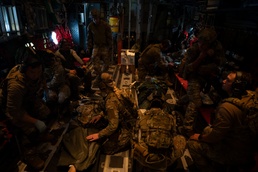
Air Commandos assigned to the 1st Special Operations Wing conducted casualty evacuation training aboard an MC-130J Commando II, Nov. 4, 2025.
The training was part of Air Force Special Operations Command’s Special Operations Forces – Medical Skills Development, the multi-day course focuses on cultivating highly motivated specialists who provide trauma assessment, tier four tactical combat casualty care and casualty evacuation in direct support of SOF teams in austere environments.
“The ability to provide patient care in a variety of challenging environments is essential for a SOF medic,” a SOF-MSD instructor said. “As AFSOC continues to adapt to rapidly changing global threats, CASEVAC training on a variety of platforms allows SOF medics to be adaptable to the needs of an ever-changing mission.”
SOF medics can face high operational tempos, environmental extremes, and physical risks to provide life-saving medical interventions within high-pressure situations, requiring exceptional problem-solving skills and decisive action under duress.
During the training, they worked through realistic trauma scenarios using high-fidelity manikins while exposed to the same aircraft dynamics, noise, and movement they would encounter in a combat environment to understand its effect on both medical providers and patient stability.
The MC-130J Commando II’s ability to support infiltration, exfiltration, and emergency medical evacuation across contested and austere locations makes CASEVAC competency a critical skillset for AFSOC personnel, said the instructor.
“CASEVAC is a core component of the SOF-MSD course, and training on an airframe is essential to properly prepare SOF medics to execute their core mission,” the instructor explained.
Before takeoff, SOF medics joined the MC-130J aircrew for a mission brief where they coordinated personnel, equipment, and patient weight estimates with loadmasters, aligned communications plans, and reviewed anticipated medical needs such as cabin pressurization and temperature adjustments.
“We learn to provide medical care in the most austere conditions with limited resources,” said a SOF-MSD student. “We also develop adjunct skills such as properly securing patients on different airframes. Learning to work as a team is just as important.”
The 1st Special Operations Wing supports regular, integrated training events to ensure Air Commandos remain ready to rapidly respond in support of special operations missions around the globe.