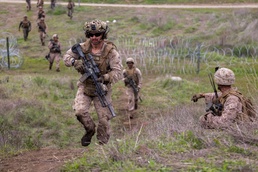
A new live-fire range is giving Marine infantry units the unique ability to train entire companies with reinforcements using the full arsenal of weapons available to the infantry battalion at Marine Corps Base Camp Pendleton, California.
Range 710A was used for the first time in December 2025, when Marines with 1st Battalion, 5th Marine Regiment, 1st Marine Division, conducted a Marine Corps Combat Readiness Evaluation (MCCRE) to prepare for their 2026 deployment on the Marine Rotational Force – Darwin Marine Air-Ground Task Force. The new range enables a company reinforced with combat engineers and other enablers to conduct live-fire training in one location.
The need for the new facility arose after severe weather rendered a previously used training area, Range 600, inaccessible. Following the weather event, Lt. Col. Mark Saville, the commanding officer of 1st Bn., 5th Marines, suggested finding a new area that could support complex, live-fire training for a company reinforced on which every weapon system organic to an infantry battalion could be used.
Developers from 1st Bn., 5th Marines identified a potential site, formerly a vehicle convoy operations range. They surveyed the area to determine surface danger zones and worked closely with base range control officials to confirm that all of the battalion's weapon systems could be safely employed.
For the MCCRE, the battalion's intelligence section developed a comprehensive layout for the simulated adversary force and a detailed obstacle plan to challenge the attacking Marines.
Engineers with 1st Combat Engineering Battalion, 1st Marine Division, were instrumental in preparing the range. They excavated trench systems, built bunkers, established mortar firing positions, and constructed wire obstacles. The same engineers then integrated with 1st Battalion, 5th Marine Regiment to participate in the evaluation. The exercise also included a full rehearsal of simulated casualty evacuations to a field medical facility.
“I want to give specific thanks to the Marines from 1st Platoon, Bravo Company, 1st CEB,” said Gunnery Sgt. Jason Lintz, the assistant operations chief for 1st Bn., 5th Marines, and one of the lead developers of Range 710A. “Not only did they construct all of the enemy obstacles and trenches for the MCCRE, but they then integrated into 1st Bn., 5th Marines to execute the MCCRE with them. We could not have done it without them."
The MCCRE unfolded in distinct phases:
First, a fire support team, Combined Anti-Armor Team (CAAT), M252 81mm mortar team, and scouts executed shaping operations to neutralize enemy air defense, mortars, and vehicles. During this phase, the CAAT fired two BGM-71 tube-launched, optically tracked, wire-guided anti-tank missiles, destroying a heavy machine gun bunker. While Marines coordinated with 3rd Marine Air Wing assets, no live air support was used, though it is a capability sought for the range in the future. Similarly, simulated artillery fire was coordinated with the Fire Direction Center of 1st Battalion, 11th Marine Regiment, 1st Marine Division, with the goal of incorporating live artillery in future exercises.
Next, the reinforced infantry company crossed the line of departure and moved to its assault position. Leaders conducted a reconnaissance of the objective area while M224 60 mm lightweight mortar teams set up in their firing position. As M252 81 mm mortar teams began suppressing one of the objectives, M240B medium machine gunners and Mark 19 40 mm automatic grenade launcher teams began engaging enemy bunkers and trenches.
With the enemy positions suppressed, combat engineers breached a path through an obstacle belt using an anti-personnel obstacle breaching system. The first platoon pushed through the breach to seize the initial objectives. The second platoon followed, clearing bunkers and trenches with M67 fragmentary grenades and using the M3E1 multipurpose anti-armor anti-personnel weapon system to destroy enemy medium machine gun positions before seizing a mortar position. Finally, the third platoon advanced to assault a squad-sized element at the enemy command post, securing the final objective.
After reaching their limit of advance, Marines began analyzing enemy intelligence left behind during the assault, completing the final phase of their evaluation on the new range.
"To see it all come together was incredible," said Chief Warrant Officer 3 Joseph Carlisle, the battalion gunner for 1st Bn., 5th Marines, and one of the lead developers of Range 710A. "We went from an old vehicle convoy operations range to a dynamic battlefield where a company commander can train his full formation in force. Having engineers, mortars, missiles, and machine guns all operating live together provides a level of realism you can't get anywhere else. This range isn't just a place to shoot; it's a place to forge a lethal, integrated warfighting team."