FORT KNOX, Ky. — It’s said that the journey is often more rewarding than the destination.
For one century-old fragment of laminated wood, the journey began while soaring over the wooded landscape of Central Kentucky on March 7,1921.
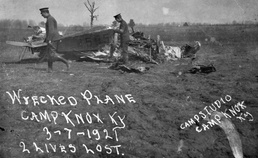
Historical records indicate that 2nd Lt. J.T. Lawson and Pvt. Joseph Reade had been practicing tailspins over the newly minted Camp Knox – established 2 ½ years prior – in a U.S. Army Curtiss JN-6H “Jenny” biplane when something went horribly wrong.
Investigators later surmised some kind of mechanical failure or strong winds had led to Lawson’s failure to pull out of his final tailspin.
“[Lawson] had performed this feat many times,” from a Louisville Courier Journal article published two days after the crash, “but some trouble, it is thought, prevented the successful completion of the stunt.”
Photos of the wreckage taken shortly after the crash reveal the extent of the damage. The unrecognizable heap of splintered wood, twisted metal, and ripped cloth that was once the front of the airplane suggest the aircraft took a hard nosedive to the ground. The back of the airplane remained mostly intact. Both men were killed.
A day later, the Courier Journal published what was described as the last known photo of Lawson before his death. Two days later, the Hartford Courant published his obituary. Camp Knox had given Hartford’s local resident full military honors in a ceremony attended by post commander Brig. Gen. William Lassiter. His flag-draped casket was ceremoniously placed in a train car as a bugler played taps and a rifle squad fired three volleys, and Lawson then traveled back to Hartford for the last time.
Talk of the accident and the formal investigation into what went wrong soon faded from the landscape, forgotten by time.
Several decades later, Susie McGinley of Altoona, Pennsylvania found a fragment of wood while she and her sister cleaned out the attic of their recently deceased grandfather. Not much thought was given to it at the time.
Thirty years passed.
Earlier this year, McGinley reached out to Dan Ergler – her next-door neighbor. She told him of the mysterious fragment she had found years before, and how it had an inscription carved into it that added to the mystery.
He inquired about it, so she showed it to him.
The engraving on one side of the fragment, painted dark brown, reads: “PIECE OF AREOPLANE (sic), THAT FELL MAR 7 1921, KILLING, PILOT LIUT LARSON, PVT REED, CAMP KNOX, KY” The other side appears to have four holes in it and a dark red-natural tone-dark brown striped pattern. There is also a hole drilled at the top, which Ergler suggests was made after the crash:
“[It] may have been for the purpose of displaying the piece.”
With help from another neighbor, Bob Hammaker, Ergler discovered that information from the engraving, though the names were misspelled, aligned with the story about the fated airplane crash of 1921 at Camp Knox.
“Immediately, we realized the importance from a historical point of view,” said Ergler. “We also all agreed that we need to find a home for it. I agreed to take it and see what I could find.”
His search led him to Ty Reid, director of the General George Patton Museum of Leadership at Fort Knox. Though Reid was unable to accept the piece at that time due to museum restrictions, he directed Ergler to Niki Mills, Fort Knox Cultural Resources manager and director of the Cultural Heritage Center in the Henry House.
In the meantime, Ergler shared the story of the wood fragment with a friend of his, John Stubecki, who lives in New York state. During Stubecki’s research, he learned that the Glen Curtiss Museum is located in Hammondsport, New York, near where Curtiss airplanes were once built.
Ergler and Stubecki carried the fragment to the museum, and talked extensively with a Mr. Blaney about what the fragment could be – part of the rudder? a corner of a wing? or something else?
Though the museum’s educator, Andre Wigley, was not in at the time, Ergler received his contact information and reached out to him for his expertise. Soon, he received a written response from Wigley:
“Thanks for reaching out! My first guess was part of the rudder of a JN4D, going purely off of the tricolor paint scheme. However, it doesn't seem to have any doped fabric on it. Though the only place where you would find a tricolored area on an Army Jenny would be on the rudder; the rudder is made of thin struts of wood, not flat planks. The only places on a Jenny that use planks (that I am aware of) would be on the instrument panel or on the footboard in the cockpit. The rest of the plane is just stretched fabric over wooden struts. Though it’s a total guess, the screw holes in that piece I bet would be where the rudder pedals screw in, since that's the only rectangular screwed-in object in those boards."
According to Ergler, Stubecki searched online afterward for information about the 1921 crash and found the newspaper article from March 9, 1921, that described the event.
“The plane struck the ground inside the Camp Knox reservation, near the quarters of the Eighty-first Field Artillery,” from the article. “During the afternoon several officers were ordered to make practice flights, in order to preserve the morale of [Heavier Than Air Detachment].”
The article stirred Stubecki’s curiosity and determination for answers.
Based on the description of the accident in the Courier Journal article and the realization of what the artifact could be, Ergler said Stubecki posed some profound questions – especially since there appears to have been no formal conclusion as to the cause of the crash.
“Could it be that the loss of control of the airplane on that day in 1921 was due to a failure of the rudder controls at the point where the peddles were mounted to this piece of the floorboard?” Ergler said. “Could it be that this piece holds the evidence of the actual root cause of the accident?”
Ergler said only reopening the case would yield answers, something that could someday lead investigators to Mills’ door. She recently received the artifact from Ergler and will include it in a Cultural Heritage Center display about aviation history.
“[Ergler] is super excited, super nice, and very generous,” said Mills. “He put a lot of work into tracking all this down, so it’s great that he has recognized the significance of this artifact. This piece symbolizes how far back our aviation history goes at Fort Knox.”
Ergler’s efforts have uncovered even more mysteries. There are no surviving members of the McGinley family who lived in the house where the fragment was found, and Ergler hasn’t found any relatives who served at Camp Knox in 1921.
“We’ve talked often about how it boggles our minds to think that someone visited the crash site 104 years ago, picked up the fragment, eventually engraved on it and then kept it for who knows how long,” said Ergler. “Then, it somehow ended up in the attic of a house in a small town in Central Pennsylvania for who knows how long. Then 30 years ago, Susie discovered the piece of wood in a box in that attic and realized it’s something she should hang on to.”
Sometimes the hardest answers to find are the how and why of a journey: those hidden steps taken between the beginning and the end.
For one fragment of wood, that journey began and ended at Fort Knox, revealing a once forgotten story. How it made its way to Pennsylvania may likely forever remain a mystery.