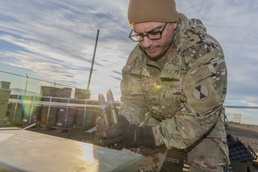
YAKIMA TRAINING CENTER, Wash. — Soldiers with 1-2 Stryker Brigade Combat Team conducted a week of day and night 30mm gunnery at Yakima Training Center, employing an experimental Stryker system equipped with a 30mm auto-cannon in a full training environment. The event incorporated Operational Network (OPNET) connectivity and the Digital Range Training System, enabling crews to use Instrumented Player Units inside their vehicles to track, record and enhance performance throughout offensive and defensive lane iterations. “We’re only the second infantry brigade to train with the Stryker-mounted 30mm weapon system,” said U.S. Army Capt. Jarid Prahl, assistant operations officer for 2nd Battalion, 3rd Infantry Regiment. “So it’s also been unique to be on the cusp of the Army’s modernization initiatives, helping to advance the force and change the way we fight in the future.” Leading the range was U.S. Army 1st Lt. Derrick Eng, who served as the officer in charge for the 30mm gunnery. Eng coordinated movement of vehicles, allocation of digital systems and communication across the range to ensure each crew received the full benefit of the experimental platform and supporting technology. “It’s a complex system that requires tight synchronization,” Eng said. “Seeing crews qualify and adapt to a brand-new weapons platform while integrating digital tools shows how quickly Soldiers can learn and succeed when given the right resources.” The 30mm rail gun introduces new challenges compared to legacy mounted systems, requiring crews to incorporate sensors, optics, and fire control software while maintaining situational awareness inside the Stryker. During gunnery, vehicle commanders and gunners relied on digital displays and real-time system feedback to assess positioning, track target effects, and adjust fire based on terrain and movement. OPNET connectivity allowed data to flow between vehicles and the range infrastructure, giving crews access to information that supported decision-making without losing focus on execution. “This system brings a level of complexity and capability we haven’t had before,” said Spc. Nicolas Taylor, an infantryman assigned to 2nd Battalion, 3rd Infantry Regiment participating in the live-fire. “You feel a different kind of adrenaline when you’re operating it because you’re learning something entirely new. The 30mm gives you so much versatility—from airburst munitions to high-explosive rounds—and with the training we’re getting, you really see how efficient and effective the system can be.” Taylor’s platoon leader, 1st Lt. Catherine Ortiz, observed their training and had nothing but positive things to say about their training and work. “They have been working on learning these new trucks and their time and dedication to learning paid off,” said Ortiz. “Watching our crews work through fatigue, adjust to a new Stryker, and still perform at a high level is exactly what we want to see from an Infantry formation. I’m proud of each of them and I know they will continue to excel.” As crews transitioned between offensive and defensive positions, the Digital Range Training System recorded weapon engagements, vehicle movement and timing across each lane. The IPUs allowed Soldiers to compare their actions to established standards, helping them identify communication gaps, timing delays, or positional errors. The ability to review data immediately between iterations gave crews the opportunity to refine their approach during the same training cycle rather than waiting until the end of the week. Leaders noted that the digital enhancements supported more objective evaluations during gunnery tables. Instead of depending solely on observer assessments, crews could replay engagements, verify impacts, and understand how decisions inside the vehicle shaped each outcome. The recorded data reinforced communication, coordination, and adaptability—skills that remain central to mounted operations across the brigade. “It’s always fun being able to go out and do Infantry things as an Infantry battalion,” Prahl said. It’s been a great pleasure to help facilitate our teams and crews doing exactly what they came in the U.S. Army to do.” By combining live-fire gunnery, experimental equipment, and data-driven training tools, 1-2 Stryker Brigade Combat Team continues to push forward in modernization efforts. The brigade’s early adoption of the 30mm system positions its Soldiers to support future operational requirements while developing a deeper understanding of combat vehicle lethality.