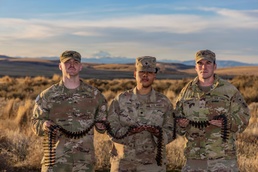
YAKIMA TRAINING CENTER, Wash. — Soldiers from 2nd Battalion, 3rd Infantry Regiment, 1-2 Stryker Brigade Combat Team spent the week conducting day and night Table V gunnery at Yakima Training Center, integrating the M2 .50-caliber machine gun and Mk 19 grenade machine gun through the Commonly Remotely Operated Weapon Station–J (CROWS-J). The system allows crews to employ heavy weapons from inside the protection of the Stryker while maintaining accuracy, observation capability, and target discrimination.
The exercise offered U.S. Soldiers the chance to refine mounted fundamentals—safe weapon operation, communication, and precision fire—while operating the CROWS-J in both offensive and defensive scenarios. By combining the remote weapon station with the Stryker’s optics and fire control systems, crews worked with multiple ranges, sight options, and digital stabilization features as they built confidence in the platform and in one another.
During the exercise, each crew moved through dry-fire, blank-fire and live-fire iterations to reinforce the fundamentals needed before employing the remote weapon system They began with safety checks, headspace and timing verification, and function tests before transitioning into loading drills and internal crew coordination. These steps gave crews the opportunity to rehearse roles, confirm fire commands, and identify any potential issues before live ammunition entered the weapon station.
“The .50-caliber weapon system achieves massive fire suppression over most light adversaries, and it’s the most casualty-producing weapon system organic to a Stryker platoon,” said 1st Lt. William Van Pamelen, platoon leader and CROWS-J range officer in charge. “The CROWS-J allows gunners to use advanced technology and thermal sights to see in all weather conditions while maintaining the protection of the vehicle.”
Once crews completed their preliminary checks, they advanced to the live-fire tables. Gunners engaged stationary and moving targets from the M2 .50-caliber machine gun, adjusting for elevation, distance, wind, and vehicle movement through the stabilized optics inside the Stryker. Communication between the gunner, vehicle commander, and driver remained essential as crews worked together to identify targets and maintain orientation while operating remotely.
“This was actually my first time ever shooting the .50 cal,” said Spc. Jenny Vang, a signal support specialist. “It was so exciting being able to shoot a higher weapon system that a lot of other Soldiers don’t have access to.”
Throughout the week, instructors evaluated each crew’s communication, rate of fire, target ID, and ability to clear stoppages—all while maintaining control of the weapon through the CROWS-J interface. U.S. Soldiers spent time between iterations inspecting feed systems, confirming optics settings, and rehearsing immediate action procedures. The remote weapon station required crews to understand both the mechanics of the M2 and the digital interface that operated it.
“You’re tested on your ability to recognize distance, direction and the type of vehicle—and then successfully engage it,” said Spc. Kenneth Garcia.
Along with the M2, 2-3 Infantry also employed the Mk 19 grenade machine gun through the CROWS-J system. The Mk 19 provided crews the ability to cover dead space and deliver high-explosive rounds at extended distances without relying on external mortar support. Its arcing trajectory and area effects complemented the direct-fire capabilities of the .50-caliber weapon system, giving crews multiple options for suppressing or shaping an objective.
“The Mk 19 achieves the same goal as the .50 cal, but brings the advantage of covering dead space and using high-explosive rounds,” Van Pamelen said. “It provides another layer of flexibility for the platoon.”
Leaders said the ability to employ both the .50 cal and Mk 19 from inside the vehicle represents a significant step toward enhanced crew protection and mounted lethality.
“With the CROWS-J, the gunner is able to fire from inside the vehicle rather than on top,” said Capt. Jarid Prahl, assistant operations officer for 2-3 Infantry. “It keeps the gunner safe and protected inside.”
By the end of the Table VI cycle, crews demonstrated stronger coordination, improved target engagement times and a clearer understanding of how the CROWS-J changes mounted gunnery. For the U.S. Soldiers of 2-3 Infantry, the week at Yakima Training Center offered more than qualification—it reinforced the skills and technologies that shape how mounted units fight on today’s battlefield.