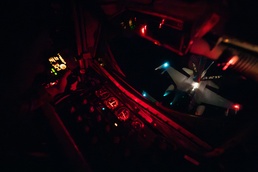
Airmen assigned to the 86th Aeromedical Evacuation Squadron here trained alongside aircrew assigned to the 100th Air Refueling Wing at RAF Mildenhall, United Kingdom, during a KC-135 Stratotanker aircraft training that supported air refueling and aeromedical evacuation training at Ramstein Air Base, Dec. 9-11.
The training included patient and aircraft emergency response scenarios, medical interventions and crew coordination procedures.
“This week’s training maximizes a limited window to build readiness across the team,” said Maj. Amanda Peterson, 86th AES assistant director of operations. “We are maintaining currency, completing evaluations, upgrading students and giving our crews hands-on experience on a platform they could be tasked to operate on with little notice.”
Aeromedical evacuation Airmen are trained to provide care on multiple types of aircraft. While the 86th AES frequently flies on other platforms, the KC-135 presents different systems and configurations that require repetitive practice.
“Each aircraft has unique electrical and oxygen systems, as well as different loading considerations,” Peterson said. “Training on the KC-135 ensures our nurses and technicians stay adaptable and mission-ready for what the theater requires.”
The visit also allowed aeromedical evacuation training to occur alongside air refueling operations, a scenario not typical for routine operations, but one that can make or break time sensitive situations.
“Combining these events introduces additional risk factors and coordination requirements,” she said. “Training it in a controlled environment ensures crews understand how the aircraft behaves and what decisions matter when patient care and aircraft operations overlap.”
For Senior Airman Bryce Wallace, 86th AES aeromedical evacuation technician, these flights helped build confidence early in mission qualification training.
“This training helps me re-familiarize myself with the KC-135 and ensures I am ready to fly on any aircraft I’m assigned,” Wallace said. “The more realistic reps we get, the more effective we are when it counts.”
The value of flying is in the environment itself, Wallace said. Noise, movement, time pressure and coordination with aircrew all play a major role.
“When we are physically on the aircraft and in the air, we experience the same pressures we would during real missions,” he said. “That is what makes it meaningful.”
The tanker aircrew also gained experience working closely with an aeromedical evacuation team. A mission set not routinely conducted by every refueling unit.
“This is my first time supporting an aeromedical evacuation training mission,” said Staff Sgt. Jonathan Ross, 351st Air Refueling Squadron boom operator instructor. “It helps us understand their procedures and how we can support them effectively if we are tasked with this in a real-world scenario.”
As the global gateway across U.S. Air Forces in Europe - Air Forces Africa, Ramstein regularly connects airpower, mobility and medical response.
“Ultimately, this is about being ready for the call,” Peterson said. “Shared training builds the competence and confidence we need to move patients safely, anywhere the mission requires.”