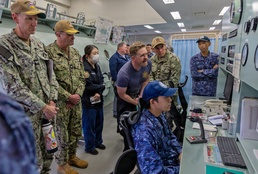
YOKOSUKA, Japan — Commander, Submarine Group Seven; U.S. Naval Hospital (USNH)Yokosuka; Japan Self-Defense Force (JSDF) Hospital Yokosuka; Japan Maritime Self-Defense Force (JMSDF) Undersea Medical Center and the U.S. Naval Ship Repair Facility and Japan Regional Maintenance Center’s (SRF-JRMC) Navy Dive Locker conducted a joint emergency medical drill to improve bilateral coordination in responding to diving-related injuries.
The exercise simulated a scenario in which a U.S. Navy diver surfaced from a routine maintenance dive and developed sudden neurological symptoms consistent with a diving-related embolism. The drill tested real-time communication, coordinated transport, and the handoff of care between USNH and JSDF/JMSDF medical professionals.
“This drill gave our teams a critical opportunity to rehearse as one aligned medical network and ensure we can respond quickly to a diving emergency,” said Capt. Scott Welch, Undersea Medical Officer for Commander, Submarine Group Seven. “Our ability to integrate seamlessly with JSDF medical professionals directly affects the safety and survivability of our divers.”
As part of the exercise, U.S. Naval Hospital Yokosuka emergency medical technicians responded to a simulated dive site, conducted an initial assessment, and transported the diver for required evaluation at JSDF Hospital Yokosuka. After the rapid assessment, the diver was cleared to proceed to the JMSDF Undersea Medical Center, where the emergency team prepared the hyperbaric chamber for recompression therapy.
Dr. Reika Matsushita, a Japanese fellow assigned to U.S. Naval Hospital Yokosuka, also practiced providing medical guidance while off-base to challenge communications and decision-making under realistic conditions.
“Effective care for diving injuries depends on speed, clarity and teamwork across organizations,” Matsushita said. “This bilateral drill strengthened our shared ability to act decisively during complex medical situations.”
The SRF-JRMC Navy Dive Locker contributed operational expertise on diving hazards, risk factors and the urgency of hyperbaric treatment in suspected embolism cases. “Our divers rely on the entire medical community to be ready when seconds matter,” said Master Diver Master Chief Alberto Alejo. “Exercises like this help ensure every link in the chain is strong.”
Following the scenario, personnel from all participating commands conducted a hot-wash review at JMSDF Undersea Medical Center to identify improvements and reinforce shared procedures.
“This training underscores the ongoing partnership between Navy Medicine, the Defense Health Agency and our JSDF counterparts,” Welch said. “Together, we are committed to maintaining the highest level of readiness across the force.”