By Itzel Godinez, PhD, and William (Hunter) Spence, PE
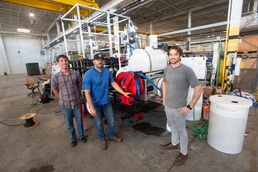
NAVFAC EXWC engineers and technicians from EXWC’s Shore Department – SH31 Environmental Compliance and Services – designed and built an innovative, trailer-mounted system to treat PFAS-impacted waters derived from land-based fire suppression systems, such as those used in hangars and on firetrucks.
The PFAS Effluent Treatment System (PETS) III is a mobile system intended to remove per- and polyfluoroalkyl substances (PFAS) from waters impacted with aqueous film forming foam (AFFF) at low to medium PFAS concentrations and low presence of co-contaminants such as total organic carbon, total suspended solids, and total dissolved solids.
By removing low- to medium-range-concentration PFAS from large volumes of impacted waters, PETS III is expected to help avoid the disposal of an estimated 710,000 gallons of PFAS-impacted waters for a projected net savings of $2.6 million over the course of its current deployment at Naval Air Facility Atsugi, according to the project’s Program Manager and PFAS Subject Matter Expert Dr. Itzel Godinez.
“PETS III consists of a specialized treatment train that supports the treatment of PFAS-impacted waters. The treatment train comprises pre-treatment, filtration and sorption media. Each treatment step is a modular skit arranged on a trailer,” Dr. Godinez said.
“The latter provides the flexibility to make adjustments to the treatment train in future iterations of the system to target specific PFAS discharge requirements,” she said. “Currently, we are also exploring variations to the treatment train to comply with both PFAS discharge requirements and specific chemicals present in fluorine-free foams (F3) that have discharge requirements.”
The PETS III works by pumping water out of a wastewater pond and processing via screening, foam fractionation, filtration, granular activated carbon, and ion exchange resin. The system features a more advanced fluid handling system with independent variable speed pumps for the fluid intake and treatment process feed flows. The system has various pressure sensors and flow meters that allow for automatic sensing and regulation of intake flows, process feed flows, fluid pressure, tank fill levels, and treatment media changeout intervals.
“I am proud to say that the PETS III system was designed and built entirely in-house by our team. To make this possible, we had to learn and apply quite a number of new technical skillsets and often improvise solutions when our planning and design work needed revising,” according to Senior Project Engineer William (Hunter) Spence, who served as the project’s system design and fabrication technical lead.
“Being directly involved in all phases of the effort allowed us to quickly pivot, revise, and iterate as needed to keep things on track and meet our deadline. While this project was very challenging, the opportunity to go from designing a system to physically building, configuring, and testing our designs was an invaluable learning experience. The new skillsets we gained and lessons learned have made our team much more capable,” he said.
The PETS III is based on designs by the Army Engineer Research and Development Center (ERDC) for its PETS mobile system designed to address PFAS contamination in water. The EXWC team advanced this technology by reconfiguring the treatment train, which now includes a pre-treatment step to avoid premature fouling of the filtration and sorption media steps, ruggedizing the system, and making its PLC/HMI more user friendly.
“As delivered, the reconfigured system is the smallest and most portable trailerized water treatment system that features a foam fractionation pre-treatment step. Integrating this process while still fitting the system in a standard high-cube shipping container was a big challenge that required rethinking both the original pipe connections, pumping scheme, and the control system,” Spence noted.
The system took three years to design, build, test, and deploy. The PETS III was subjected to shakedown testing and manual start-up operations of the different treatment steps at EXWC before shipping overseas. EXWC deployed the PETS III to Naval Air Facility Atsugi in October 2024 and hopes to deploy additional units based on customer needs.
PFAS are a large class of chemicals found in many consumer products, as well as in industrial products such as certain firefighting agents called aqueous film forming foam, or AFFF. They are long-lasting chemicals and scientific research suggests that exposure to certain PFAS may be harmful to human health.
The Department of the Navy (DON) is implementing a comprehensive strategy to manage and address the known or potential presence PFAS from DON activities on Navy and Marine Corps installations, facilities, and bases nationwide.