Navy Medicine operational readiness is predicated on the foundation it is built upon.
Establishing that framework has been an ongoing developmental responsibility at Navy Medicine Readiness Training Command Bremerton.
Welcome to Battle Ready Training Tuesday, a command-wide initiative focused on providing preparatory skills training primarily for hospital corpsman yet open to all staff members.
For Hospital Corpsman 2nd Class (Enlisted Expeditionary Warfare Qualification) Adam Redman, NMRTC Bremerton Family Medicine Center leading petty officer, his active involvement in coordinating and providing the training has gathered momentum as the weekly sessions continue to attract a sizable number of staff.
“The goal is to further hone our operational readiness and mission capability with basic skills,” said Redman, noting that the program was established under the direction of Captain Heather Kirk [NMRTC Bremerton chief nursing officer], who consolidated several independent command training efforts into the formal working group.
“Its origin lies in a recognized need to enhance core competencies, streamline training into a single, digestible package, and reinforce the hands-on skills required for the hospital corpsman personnel qualification standards. The result is a training plan grounded in mastering the basics of patient care,” explained Redman.
The training is provided by experienced providers, nurses, and corpsmen who teach and guide those in attendance through challenging simulations.
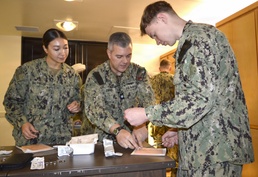
Hospital Corpsman 2nd Class Kaitlyn R Cooper helped provide guidance and instruction during the hands-on suture skills training held December 16, 2025.
The training session allowed corpsmen in attendance to practice complete sequence of care in a small group setting concentrating on the proper donning of sterile gloves, wound flushing and preparation, simulated local anesthetic administration, and suture techniques on high-fidelity skin models.
Cooper taught the wound flushing and preparation stage.
“Irrigating the wound is a crucial step in patient care. It has to be thoroughly done to get rid of any debris, stop infection, and clean out any blood, discharge or anything else limiting visualization of the wound,” said Cooper. “Being part of our Urgent Care Clinic gives me a lot of different experiences that our other corpsmen might not have had yet. I get to share that helping here and I love teaching. It’s a favorite part of my job as a corpsman.”
The training sessions are generally scenario based, having the corpsmen work in small groups with an instructor - like Cooper - to achieve specific learning objectives. To encourage interaction and critical thinking, groups rotate through several instructors who each present a unique scenario.
“This level of interaction between corpsmen, nurses and providers has created a collaborative learning environment where everyone can contribute and learn from. At the end of each session, a debrief is held with the participants to gather feedback and topic suggestions, and a separate debrief with the instructors to refine the training process,” Redman said.
Redman attests that the training was initially designed for ambulatory care corpsmen in direct patient care roles. But the format has proven beneficial for all command corpsmen, including those who may not have regular opportunities to practice these skills.
“The goal is to enhance operational readiness. Effective medicine is rooted in fundamentals like taking vital signs, gathering patient histories, and communicating clearly with the medical team. The skills taught in this program are the foundation for our Sailor’s future success,” stressed Redman.
One recent training session was specifically tailored for corpsmen who graduated from the Navy’s school for their rate but do not have any additional specialized training. The instruction addressed recognizing abnormal vital signs in the field – ranging from hypothermia to hyperthermia - with hands-on guidance provided to allow the corpsmen to identify patterns, prioritize urgency, take action and conduct reassessment for a wounded patient in the field.
Each training is designed to be accessible to all, regardless of rank or experience level, with each session beginning with an introduction to the topic and a clear outline of training objectives.
“The true success of this program is measured by the individual Sailor. We want them to leave with a key insight that clicks into place when they face a real-world challenge. It's also a mutually beneficial experience, empowering our instructors to become better leaders by strengthening their own skills through teaching,” Redmon said.
“On one level of importance, we’re able to bridge the gap in skills expected from our providers and multifaceted teams, along with showing the people who make up the bulk of our workforce that we are dedicated and invested in them,” continued Redman. “Our nurses have been vital to this effort as preceptors, building a rapport with Sailors that they might not have been able to before.”
Redman also stressed the committed encouragement and guidance from command leadership has been a driving force for the entire training team. “The support from instructors and command leadership has been truly essential to the program's success,” he said.
“We’re making sure this training is all applicable and aligned with our focus on Navy fleet readiness. This is our own [Navy Medicine] deployment readiness focus to get us where we need to be as a ready medical force,” stated Kirk.