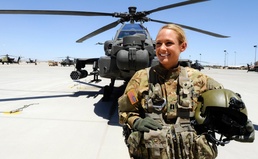
WASHINGTON — During one sweltering summer in upstate New York, Lindsey Danilack sat back in her barracks room, weary from drills and cadences. She had spent hours carrying a 50-pound ruck in her first march.
Now in the opening days of the U.S. Military Academy’s “Beast” or Cadet Basic Training, she pulled up the pant leg of her camouflage trousers and removed her boots to find her feet covered in blisters. Danilack, who had just begun her initiation into West Point in the summer of 2010, started to doubt herself.
“My feet were so ripped up,” said Danilack, now Lindsey Chrismon. “I was bleeding through my shoes.”
An accomplished track athlete who had competed in the Junior Olympics, she had never endured something as demanding as the six-week basic training, which prepares cadets for four years of military school.
“I didn't understand where [we were] going or why we were marching in a line,” she said.
She had not applied to any other college than West Point. She had dreamed of attending West Point since age 11, but she privately questioned her decision. Still, she remained committed to graduating, she said.
Even when the odds seemingly stacked against her, Chrismon welcomed challenges.
“She was the plebe [freshman] that would stay up all night and clean her room and dust in between the floor cracks,” said fellow West Point alum and husband Gabe Chrismon. “Just her attention to detail is off the charts.”
Chrismon’s reaction: try harder than everyone else. That attitude eventually propelled Chrismon to heights she couldn’t imagine.
Not only did Chrismon pass basic training, she quickly mastered balancing athletics and military duties during her plebe year at the academy.
“I would think to myself, wow, everyone else is so much better than me,” she said. “Everybody has done so much more. I'm a nobody here.”
At an institution that has bred some of the nation’s top decision makers, Chrismon stood out among her peers.
She captained West Point’s women’s track team, competing in the 400-meter hurdles, the pentathlon and the heptathlon. She helped lead the Black Knights to their first win over Navy since 2007.
Finally, Chrismon’s drive eventually led her to becoming the fourth woman in West Point history to serve as First Captain of West Point’s Corps of Cadets for the 2013-2014 academic year, ranking at the top of her class.
Chrismon’s path to the Army and West Point can be traced to a childhood trip.
A childhood pact
During one July day in upstate New York, 11-year-old Lindsey, her parents and brothers travelled to the USMA campus for a picnic. They sat at Trophy Point, a popular tourist spot nestled between West Point’s rolling hills. On one end, onlookers can gaze upon the entire USMA campus and in the other: a picturesque view overlooking the winding Hudson River.
There, enamored by the military display of new cadets performing combatives, Chrismon decided her future.
“I just fell in love with the atmosphere,” she said.
The middle schooler surprised her parents when she told them she wanted to attend West Point. Born into a non-military family, she had always focused on schoolwork and enjoyed studying.
Chrismon said she grew up a “tomboy,” spending her springs and summers riding her bike through Montville, a New Jersey suburb of 22,000, about 30 miles west of New York City. She, her brothers, and her best friends would build tree forts in patch of woods near her family’s suburban two-story home.
Chrismon had always been headstrong, first dabbling in youth sports at age 5 and competing in soccer, basketball and track in high school. She enjoyed playing on the drumline for her high school marching band.
Although West Point recruited her for the women’s track and field team, she still had to undergo the rigorous application process which included a letter of recommendation from her congressman.
During her four years as a West Point cadet, her peers called her a “natural leader,” and she learned to pulled relationships with fellow cadets first as the commander of plebe basic training, then as first captain. Chrismon said the role of first captain prepared her for the operational Army.
Joining the Army’s best aviators
Moving from one milestone to the next characterized Chrismon’s decade in the Army. In her first assignment at Fort Bliss Texas, Chrismon flew possibly the U.S. military’s most lethal attack helicopter, the AH-64 Apache. She had circled aviation as her only career choice early in her years at West Point.
After four years flying the Apache, Chrismon wanted to take on an assignment that would test her abilities further.
She had always admired the capabilities of the AH-6 Little Bird and the difficult stealth
operations the Army uses the aircraft for in the 160th Special Operations Aviation Regiment. Little Bird pilots are comprised of some of the most elite, experienced rotary wing aviators in the Army.
No woman had ever successfully assessed to fly the AH-6 Little Bird, so attempting to do so and failing could hurt her career, she said.
The words “doubt” and “challenge” only fueled her ambitions, Chrismon wanted to continue to serve her country in the most elite helicopter force on the planet.
She applied for a slot to assess as a pilot of the AH-6 Little Bird, a light attack helicopter designed to deliver precision fire support during special operations missions.
Qualifying to fly the air frame posed a difficult hurdle for even veteran pilots.
Chrismon said when loaded with rockets, minigun ammo, and fuel, the airframe can be challenging to maneuver requiring the pilot to multitask on a graduate level.
“There's no hydraulics and it's very power limited,” she said. “So, your power margin is very, very slim … you're flying in a very aggressive profile where you're aiming the aircraft at the target. This aircraft doesn't have articulating pylons like the Apache does, everything is fixed.”
Chrismon said the aircraft requires pilots to manually maneuver into a unique attack profile while simultaneously firing to engage targets. Little Bird missions also demand flying at extremely low altitudes, even on the darkest nights, requiring precision, speed, and total focus to execute complex attacks.
After a brutal week-long assessment, and months of OGP training, Chrismon became the first female in Army history to fly the AH-6 Little Bird and quickly earned the respect of veteran pilots in the 160th.
As a new member of the 160th Special Operations Aviation Regiment, she moved to Fort Campbell, Kentucky, which sits on the Kentucky-Tennessee state line, 60 miles north of Nashville.
“She came through with flying colors and then really hit the ground running,” said Army Chief Warrant Officer 3 Steve Scott, a fellow pilot at the 160th SOAR.. “I'm not going to mince words, but it's not unique to males or females coming through … Some pilots are just stronger.”
She had a talent for selling ideas to others, as a cadet and Soldier. Scott recalled how during one training exercise, Chrismon’s assault force coordinated an attack with a simulated ground force. Scott said Chrismon convinced the ground force to try a specific maneuver to test the capabilities of the aircraft.
“She has a very, very strange ability to get people on her side, you know?” Gabe Chrismon said. “I don't really know how else to put that, and I think she does it from just being the hardest working person in the room.
During her 10 years in the Army, she became an accomplished pilot in the AH-64 Apache and the first and only woman ever to pilot the AH-6 Little Bird for the 160th Special Operations Aviation Regiment (SOAR).
“I would say that she is driven to a challenge,” said Scott. “If there’s no challenge involved, she’s probably not going to be interested.”
After 10 years, Chrismon decided to take on a new challenge. She and her husband had ideas for forming their own company. She also wanted to earn her Master of Business Administration at a prestigious institution.
After originally planning to spend her career as a Soldier, she decided she wanted the opportunity to innovate and take risks.
“I didn’t really want to have my future completely laid out for me,” she told the Harvard Gazette. “I wanted to experiment and get out in the world and do other things and face different challenges.”
An innovative mind
Chrismon applied for graduate studies at seven schools: Chicago Booth, Kellogg, the Massachusetts Institute of Technology, Yale, Wharton, Columbia, and Harvard. All excepted her, but Chrismon had one target school on her radar.
That renowned Ivy League school, which graduated eight U.S. presidents, Nobel prize winners and leading scientists throughout history. She received her acceptance letter from Harvard to matriculate in the fall of 2023.
Chrismon admitted the atmosphere and resumes of her peers intimidated her. Harvard marked the first time she had attended a solely academic institution since high school.
“Coming into this new environment, I'm a bit older than everybody else and I have very little business background,” she said.
“So, my background was very different than my investment banker or consultant classmates. And so of course I felt intimidated by the intellectual aperture of my classmates. But I fully recognized that the value that I brought to Harvard was very, very different and important.”
While attending Harvard, she launched a venture backed artificial intelligence tech company.
In May, Chrismon graduated as part of Harvard Business School’s 2025 class. Earning a degree from an Ivy League school typified the career of Chrismon, who never shied away from taking the toughest route to achieve her goals.
Two years later, Chrismon graduated with second year honors at one of the nation’s top academic institutions.
As a track athlete, Chrismon distanced herself from the rest of the pack, outpacing the next runner by wide distance. Like she did on the running track, Chrismon stood out at every level in her military career and at the Ivy League School.
Now as a 33-year-old CEO of the venture-backed tech startup company, Chrismon continues to serve her country, this time, in slightly different capacity serving American homeowners’ needs.
In her 2025 dossier as a member of the HBS Class of 2025, Chrismon wrote “I refuse to live an uninteresting life; I will always seek adventure and challenges.”