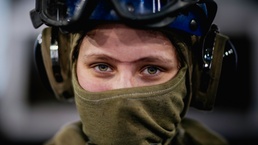
The flames crackled and hissed in front of Alex Tetrault, spitting sparks and waves of heat so fierce she could feel it against her fire-retardant coveralls. In steady, controlled breaths, she breathed in cool air through her mask as the heat rushed over her body. Every fiber of her being was focused on the roaring inferno in front of her and the nozzle in her hand as she moved it in a familiar “figure 8” pattern. She could feel the tense power of the hose that was responsible for the gallons of high-pressure water that was being sprayed on the raging fire.
It was a stark contrast to Logistics Specialist 3rd Class Alex Tetrault’s day-to-day routine of coming into work, crunching numbers and reviewing order numbers in the stock control division of supply department aboard Nimitz-class aircraft carrier USS George Washington (CVN 73). When she joined the Navy, she never imagined a fire roaring in front of her, the possibility of a fire on the flight deck of an aircraft carrier, or even more, the responsibility of extinguishing it being put in her hands. As the Surface Warfare School Command (SWSC) instructor called out to relieve the nozzleman, she transferred the nozzle to the Sailor behind her and moved to the rear of the fire attack team. That brief respite helped her realize the importance of what she was doing.
Sailors feeling the heat of a fire, the kick of water running through a hose, and experiencing realistic aircraft firefighting training is an effective way to protect naval assets, life, and preserve mission continuity by enhancing damage control effectiveness in the face of potential fire hazards.
“During bootcamp, every single Sailor in this room learned the basic fundamentals of shipboard firefighting techniques,” said Aviation Boatswain’s Mate 1st Class Marvin Etienne, a lead instructor at SWSC, during his classroom introduction. “I know that, for most of you, feeling the heat of a raging fire during a firefighting course was not in your cards for your time in the Navy.”
Tetrault looked up when Etienne uttered that statement, wondering exactly how she did in fact end up in this class. A month ago, she was working at her desk when her supervisor approached her with the opportunity to be a part of team of Sailors that will participate in vertical replenishments on the flight deck while out at sea. She’d never been close to a helicopter before, much less hooked supplies to the bottom of one, but the notion of standing underneath a helicopter was slightly threatening to her calm way of life. She wasn’t scared of actually performing the action, but of what could happen in the small chance the helicopter was to crash. Little did Tetrault know, she would soon learn what to do in that situation. Now, a month later, she was sitting at a desk in a classroom on the second floor of SWSC on Commander, Fleet Activities Yokosuka, Japan, learning the proper way to combat an aircraft fire about to conduct a literal trial by fire.“I was originally concerned with my need to attend the training,” admitted Tetrault after the class. “I thought I was just going to be doing logistics work on the flight deck and didn’t really see the need to attend firefighting training. Etienne started to change my mind about that when he recalled his real-life experience on the flight deck.”
Etienne switched the power point on the classroom screen to a freeze frame of a helicopter appearing to crash into the flight deck of a ship, a jarring image and a glimpse into what Sailors would possibly have to face.
“October 19, 2018, I was working in crash and salvage division on the flight deck of [Nimitz-class aircraft carrier] USS Ronald Reagan (CVN 76) when an [MH-60R] Seahawk crashed near the back of the ship,” said Etienne gravely, his face reflecting the emotions he felt that day. “The helicopter landed on its side, which caused some Sailors to be injured, but thankfully no fatalities occurred that day.”
Etienne looked around the room, making eye contact with his students and hoped they understood the gravity of the situation he had been in and one they could possibly experience.
“The main assets of the Navy are you, the Sailors,” said Etienne, driving home the vitality of the training before the class headed to the training complex. “The main purpose of aircraft firefighting is to save lives. Without the Sailors there is no Navy.”
Tetrault thought about Etienne’s message and realized maybe she could justify the training to herself. She wanted to be able to save lives, and she could do that by giving her all in the training that could one day lead to her doing that very thing. As the class finished, she stood up with the others to head to the next phase of training that would put their training to practical use.
“You are about to actually feel the heat and see and smell the smoke of aircraft fuel,” explained Etienne, now in the training complex with the students in a circle around him. “We are the only site in Japan that burns actual JP-8 jet fuel.”
Tetrault clutched her cranial, a head and hearing protection device, while Etienne explained what they were about to go through. She wondered how hot the fire would be and if her goggles would fog up. She realized she was nervous, but started strapping on her cranial—a sign that she was ready to face the fire.
“The situation you are about to go through is going to help you effectively and safely put out a fire in a timely manner in order to allow the ship to continue the mission,” said Etienne. “For you carrier Sailors, the mission is launching aircraft.”
He stopped pacing and turning, and held eye contact with several Sailors including Tetrault. She met his gaze with a slightly wary but determined look, reflecting how she felt about facing the inferno.
The circle of students broke into four groups under the overall instruction of Etienne; each group manned a hose with two instructors assigned to each team. Etienne positioned himself in the middle of all the teams and prepared to supervise the organized chaos that was about to take place. He nodded at his fellow instructors in the windowed room overlooking the training complex—a signal for them to sound the alarm.
A sharp unsettling alarm jumped to life, resembling fingernails on a chalkboard. Tetrault clutched her hose with her team in preparation to move in. She recognized it as the aircraft casualty alarm. The instructors signaled for the trainees to go on air; knobs turned and air hissed as 40 Sailors simultaneously activated their Self-Contained Breathing Apparatus (SCBA). Flames began to lick the bottom of the training helicopter as the trainees began to respond to the fire.
“I saw the flames grow from a fire to an inferno underneath the training aircraft, as the Sailor in front of me tested the hose agent,” said Tetrault. “Surprisingly, even though our team had never worked together, we moved towards the fiery aircraft as a unified team.”
Smoke started to creep around the room, but the SCBA’s the Sailors wore allowed them to breathe freely. A loud, jarring, hiss suddenly filled the room as four streams of water encountered fire and hot metal.
“The four teams put water on the fire at almost the exact same moment. I noticed the fire’s strength diminish for a brief moment before it flared up even stronger than before,” said Tetrault. “The steam began to mix with the smoke to create a fiery haze that was tinted orange. It looked and felt like a scene out of a movie.”
One of the instructors on Tetrault’s team yelled out to relieve the nozzleman, which in turn brought her one step closer to the inferno and the nozzle being in her hands.
“As I got closer to the inferno the less hesitant I became. Seeing the Sailors in front of me handle the hose easily, gave me plenty of confidence in the training I’d just received,” said Tetrault. A sly smile crossed her face before she began speaking again. “I think that the adrenaline also helped a little, or maybe a lot.”
Before she knew it, the inferno was directly in front of her. The heat waves and stray sparks hit her fire-retardant coveralls. In the eye of the inferno, she felt in control, her sole focus was the roaring flames in front of her. She watched the water coming from the nozzle diminish the strength of the fire which in turn increased her confidence.
“When I was at the front of the hose team, moving the nozzle in a ‘figure 8’ pattern, I felt confident and in control,” said Tetrault in a reminiscing tone. “Watching the flames flicker when the water I was spraying hit them was extremely satisfying. We were controlling the inferno.”
The cycle continued as Sailors continued to relieve their respective nozzleman and put water on the fire. Tetrault ended up once again at the front, and battled the fire with more gusto than the previous time. She eventually ended up in the middle of the line as the fire flickered out due to the sheer amount of water that was sprayed on it, and then it was over. In a blink of an eye for Tetrault, the training was already over.
“I definitely have a new respect for the importance of training in general and firefighting training on the flight deck,” said Tetrault tiredly after the training while still wearing her cranial. “Etienne drove the point home during his training and actually battling the inferno reinforced it. We have to be able to take care of a fire on the flight deck, no matter what job we are doing up there, so that we can save lives and preserve the mission.”
Tetrault left SWSC still processing all the lessons and skills she learned. The next day she sat down at her desk the next day slightly changed for the better with more skills than she previously had the last time she sat at her desk. She knew she was ready for whatever could come her way on the flight deck.