WASHINGTON, D.C – Scientists at the U.S. Naval Research Laboratory (NRL) and collaborating institutions have confirmed the first-known case of three radio-emitting active galactic nuclei (AGN) within a single ongoing galaxy merger.
The discovery, made alongside scientists from the U.S. Naval Observatory (USNO), provides compelling new evidence of how supermassive black holes grow and interact during galaxy mergers, a key process in the evolution of the Universe. Identifying and understanding these types of systems is of great interest to the Navy’s position, navigation, and timing goals. These findings are published in the https://iopscience.iop.org/article/10.3847/2041-8213/ae2002.
The system, designated J1218/J1219+1035, contains three galaxies, each hosting an actively accreting supermassive black hole. While only two triple AGN systems had previously been confirmed in the local universe, this is the first time all three black holes have been confirmed as radio AGN, marking a major step forward in understanding the role of nuclear activity during multi-galaxy mergers.
Using high-resolution observations from the National Radio Astronomy Observatory’s Karl G. Jansky Very Large Array (VLA) and the Very Long Baseline Array (VLBA), researchers identified compact radio cores in all three galactic nuclei—unambiguous signatures of AGN activity. The merger features two galaxies separated by approximately 22.5 kiloparsecs, with a third interacting galaxy located roughly 97 kiloparsecs away, all sharing similar redshifts, indicative of a single evolving system.
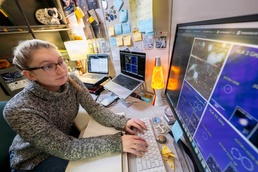
“Normally we find these in singular systems – one galaxy with one black hole,” said Emma Schwartzman, Ph.D., NRL Karles Fellow and astrophysicist. “Triple AGN are even rarer than pairs. This is the first time we’ve been able to say that all three light up in the radio regime, which is why it’s special.”
A Rare Snapshot of Galaxy and Black Hole Growth
Galaxies grow through a process known as hierarchical evolution, where massive galaxies form over time through successive mergers.
“This discovery gives us a rare window into a dynamic phase of galaxy evolution. More massive galaxies form via the mergers of other massive galaxies,” Schwartzman explained. “Finding three simultaneous radio AGN within a merging system is exceptionally uncommon, and provides valuable insight into how supermassive black holes, and their host galaxies grow and evolve.”
The three galaxies in this system have not yet fully merged, but are already interacting. Follow-up observations may reveal a physical “bridge” of matter between them — a sign of active gravitational interaction.
Multi-Wavelength Approach Key to Discovery
While initial infrared and optical observations suggested the presence of two AGN, only the new radio data confirmed all three. The radio parameters, including compact morphology, brightness temperature measurements, and steep spectral indices, are consistent with AGN-driven emission rather than star formation.
This multi-wavelength approach underscores the importance of radio astronomy in identifying hidden or obscured black hole growth. The finding also highlights the need for radio imaging in future surveys of merging galaxies, where dust and gas can mask AGN activity at other wavelengths.
“This triple system was only revealed because of the sensitivity and resolution achievable in the radio regime,” Schwartzman said. “It reinforces the value of radio observations for uncovering black hole activity that would otherwise go undetected.”
The triple-AGN system was identified using a combination of optical, mid-infrared, and radio observations, including data from the VLA and the VLBA.
Importantly, no single method alone could have confirmed all three black holes as radio AGN.
“None of those single methods alone worked perfectly,” Schwartzman said. “This discovery shows why we need multi-wavelength studies to search for pairs and triples. Many studies are just optical or just radio, but we’re convinced we need all regimes at this point.”
She added that part of the discovery came down to unexpected good fortune during unrelated research.
“We stumbled across this source in the process of another project. We were looking at a set of survey radio data and said, ‘wow, maybe there are three of them there.’ A little bit of luck, and we were able to confirm it,” she said.
Navy Relevance: Precision Navigation and Timing
NRL’s interest in AGN stems from their importance to the International Celestial Reference Frame (ICRF) — the backbone of global navigation systems, including those used by the U.S. Navy.
“Distant AGNs are used to determine our orientation in space,” said Nathan Secrest, chief of the USNO Radio Optical Reference Frame Division. “AGNs in pairs or triples create a potential source of error in this determination, so it is important to identify and study systems such as this one."
Identifying multi-AGN systems helps the Navy remove unstable sources from the ICRF, improving accuracy for navigation, timing, and space-based operations.
Next Steps
The research team plans to conduct follow-up observations in X-rays and near-infrared wavelengths to further characterize the system, including the environments surrounding each AGN and the scale of their influence on host galaxies. This data may reveal how often triple AGN occur and how they contribute to black hole mergers, events that produce gravitational waves, another important area of study.
“There’s plenty of work to do on this specific system,” Schwartzman said. “If we can highlight the bridge of matter connecting the galaxies with upcoming observations, that would be fantastic to give us insight into the merger history of the system.”
The study was conducted in collaboration with USNO, NASA Goddard Space Flight Center, George Mason University, and the California Institute of Technology, among others.
About the U.S. Naval Research Laboratory NRL is a scientific and engineering command dedicated to research that drives innovative advances for the U.S. Navy and Marine Corps from the seafloor to space and in the information domain. NRL, located in Washington, D.C. with major field sites in Stennis Space Center, Mississippi; Key West, Florida; Monterey, California, and employs approximately 3,000 civilian scientists, engineers and support personnel.
NRL offers several mechanisms for collaborating with the broader scientific community, within and outside of the Federal government. These include Cooperative Research and Development Agreements (CRADAs), LP-CRADAs, Educational Partnership Agreements, agreements under the authority of 10 USC 4892, licensing agreements, FAR contracts, and other applicable agreements.
For more information, contact NRL Corporate Communications at mailto:NRLPAO@us.navy.mil.