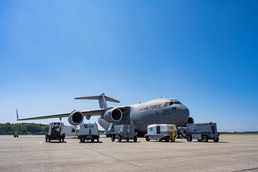
This fall, the 105th Airlift Wing activated a C-17 Combined Test Force responsible for the development, testing and fielding of technologies that will benefit the 105th Airlift Wing’s nine aircraft in various ways, as well as the entire fleet of U.S. Air Force C-17 Globemaster IIIs.
The detachment will perform operational and developmental testing and evaluation of new technologies for C-17 aircraft and support equipment.
“We have put forth this effort to improve the C-17’s ability to fight and win in the 2025 arena and beyond against near-peer adversaries,” said Col. Francis Farrelly, 105th Operations Group commander. “We want to make sure that we have our crews, as well as our jets, as ready and capable as we can possibly make them to achieve victory regardless of the threat environment.”
The idea to establish an operational test unit originated around 2022 when the 105th Airlift Wing was asked to test microvane drag reduction technology. Microvanes, 4x16-inch, 3D-printed strips, were installed on the rear of the C-17 to test their impact on fuel efficiency. Following a multi-year testing process, microvanes have enhanced mission capability and fuel efficiency at the 105th.
The 105th then began looking for more ways to enhance the capabilities of the C-17 through testing and development, which led to the activation of the C-17 Combined Test Force as a specialized test detachment.
In addition to microvane testing, they explored mission control technology with partnering agencies Rockwell Collins and Defense Advanced Research Projects Agency.
The C-17 Test Detachment is currently working on multiple other projects. They are testing adaptor improvements for the multiplex bus fault isolator by testing various adaptors’ functionality within the C-17. They are also exploring use of the battlefield assisted trauma distributed observation kit, which will enhance patient care on aeromedical missions, and testing the airlift/tanker open mission system, aimed at providing secure airborne connectivity that will give aircrew an information advantage.
The most recent project the detachment has taken on is electric ground power unit testing. The C-17 is currently powered by an external, fuel-powered generator while on the ground to enable the use of many of the aircraft’s functions, and the CTF is testing three advanced battery-powered ground power units to determine if they can support the requirements for power during ground operations.
Traditionally, the Air Reserve Component, which includes the Air National Guard and Air Force Reserves, served as a support function for the active duty Air Force to supplement wartime operations, according to Lt. Col. Joseph DeMonte, the 105th’s C-17 Test Director. However, there has recently been a shift toward using ARC personnel and assets for more technology development and flight testing.
“We in the 137th Airlift Squadron have been able to jump on top of a lot of projects and lead the way in their development and emergence within the battle space,” said DeMonte. “I think that since the Air Guard and Reserve component leadership has realized this opportunity, now we get to play a role in the development and fielding of technologies in the operational sense.”
The Airmen of the 105th are excited to tackle the opportunities that come with launching the C-17 CTF, according to Farrelly, because it allows them to focus a cohesive and expansive team across the wing to advance test efforts. They are eager to apply their skill, experience and passion to the goal of improving the lethality, connectivity and durability of the C-17 fleet with the ultimate hope of benefiting the mobility air force as a whole.