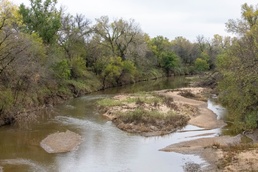
This is a story about a lake. But before you read any further, you should know this won’t be a story about water. Sure, I could tell you Kanopolis Lake has a normal pool surface of 3,460 acres and has prevented an estimated $100 million in flood damages since its construction. I could also tell you nearly 400,000 people visit the lake annually, many of whom fish, swim, boat and partake in other water-based recreation. But if I only told you about the water, you’d be missing out on what makes Kanopolis Lake truly special: the land.
Stick your finger in the center of a map of the U.S. and chances are you will come within a few centimeters, or map miles, of Kanopolis Lake. Located in central Kansas, it’s about as close to the middle of the lower 48 states as you can get. Despite its location in the center of the country, Kanopolis Lake feels quite remote.
Built in 1948, Kanopolis Lake is the oldest of the Kansas City District’s 18 lake projects and one of the first reservoirs in Kansas. Over the decades, it has become known as having one of the most robust and effective natural resource programs in the U.S. Army Corps of Engineers.
“These dams were built to mitigate floods. USACE is trusted to ensure responsible land management on behalf of the American people,” said Ryan Williams, Kanopolis Lake natural resource manager. “What first started with flood risk management became environmental stewardship and land management and then developed into recreation.”
Standing on a deserted dirt road at the edge of a field, the only sound to be heard is the wind rustling through the grass. It’s not hard to picture what settlers would have encountered as they migrated during America’s westward expansion more than 150 years earlier. That’s because much of the land surrounding Kanopolis Lake is native prairie that’s been left intact.
“We’re located within a prairie ecosystem, specifically the mixed grass ecosystem within the Great Plains region,” said Williams. “A lot of our acreage, between 4,000 and 5,000 acres, is what they call unbroken, so it’s never seen the plow. Roughly four percent of tallgrass prairie in the U.S. is unbroken. What we have is pretty rare.”
Although staff manage the water at Kanopolis Lake, the fisheries management falls to the state. As early adopters of cashless fee collection and automated reservations at its recreation areas, Kanopolis Lake staff can devote more time to land management and environmental stewardship.
“We have this huge public land resource and folks want to use it. The overarching goal is to conserve natural resources while providing public recreation opportunities,” said Williams.
In Williams’ eyes, land management and recreation go hand in hand. The better the land is managed, the better access the public has to quality recreation areas. Prioritizing land management is not neglecting recreation, it’s improving it.
“We know that if we prioritize the land management, it’s going to benefit the recreation,” he said.
From invasive species control and prescribed fires to planting native grasses and constructing habitat, there are many ways Williams and his staff manage the land at Kanopolis Lake. But there is one management practice they have fully embraced to maximize benefits: agriculture leasing.
“Kanopolis [Lake] is very unique within USACE because we retained most of the land to manage. A lot of USACE land is out granted to the state and they manage the wildlife areas,” said Williams. “Here at Kanopolis [Lake], we took on that responsibility.”
And a big responsibility it is. Kanopolis Lake staff manage about 13,000 land acres. According to Williams, he would need at least double, if not triple, the staff to effectively manage that much land. So, instead of increasing the number of staff, the lake project has gone all in on agriculture leasing. Leasing around 9,000 acres each year, Kanopolis Lake has one of the largest agriculture leasing programs in USACE.
There are three types of agriculture leasing, all of which help conserve the native prairie ecosystem: grazing, crop and hay leases. According to Williams, before the area was settled, bison grazed the land and wildfires helped control invasive species while stimulating the growth of native flora.
“The trick with prairie management is it has to have some type of disturbance,” said Williams.
Leasing land for grazing and hay helps mimic the once natural disturbance, controlling the growth of invasive species and creating habitat, all of which are essential for maintaining the native prairie ecosystem. There is also a fiscal benefit to leasing the land for agriculture. Annually, Kanopolis Lake generates roughly $300,000 through its agriculture leasing program, some of which goes directly back into the lake project to assist with managing the resource.
“For USACE, the benefits are twofold. The prairie gets the disturbance it needs and on top of that, we’re generating revenue for the U.S. government through an agriculture lease,” said Williams.
For Williams, conserving the prairie is vital for Kanopolis Lake and the many benefits it provides to the surrounding communities and the region.
“All our missions are connected, and they’re connected because of the land we use. Whether it be for flood risk management, hunting, fishing, wildlife, boating or as a source of drinking water, they’re all interconnected,” said Williams. “Without our natural resource management program, I think we would see the loss of the prairie, an endangered ecosystem.”
Thanks to the hard work of Kanopolis Lake staff, the prairie is making a comeback and it’s a destination worth visiting. Other land-based highlights worth seeing at the lake include Mushroom Rock State Park, Farris Caves, the Legacy Trail and the Big Bottom Wetland Complex, just to name a few.
So, while you might be drawn to Kanopolis Lake for the water, don’t be surprised if you end up staying for the land.